Aspiration
You likely pronounce English p, t, and k the same unaspirated way you do in Hungarian, releasing straight into the vowel without any extra puff of air, even at the start of a stressed syllable like in 'Peter' or 'top'.
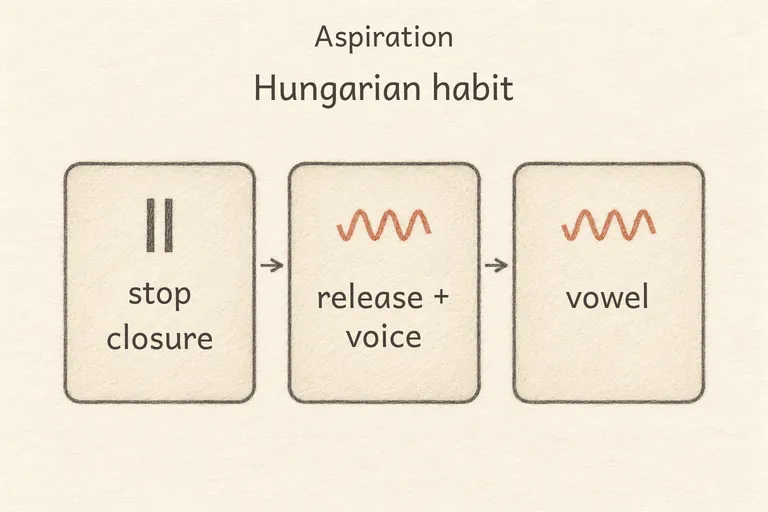
What you probably do
You likely pronounce English p, t, and k the same unaspirated way you do in Hungarian, releasing straight into the vowel without any extra puff of air, even at the start of a stressed syllable like in 'Peter' or 'top'.
How natives do it
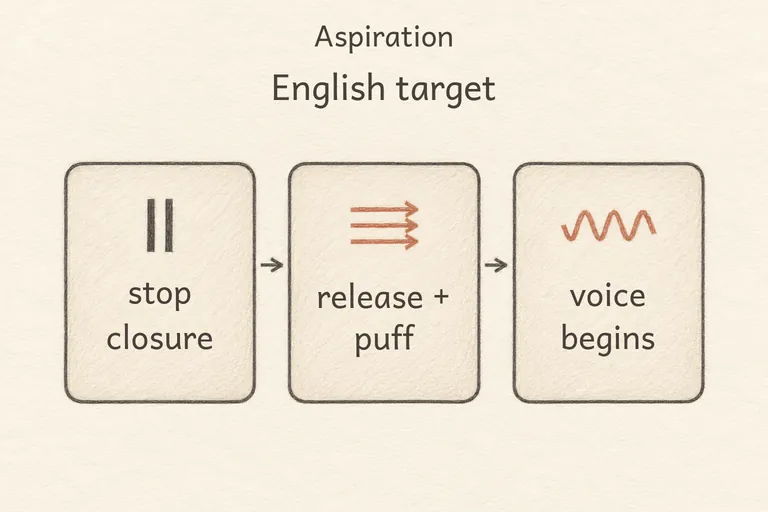
Americans add a clear burst of air right after releasing p, t, or k when it begins a stressed syllable, so there's an audible puff before the vowel starts — try holding a tissue near your mouth and feeling it move on 'pea' but not on 'spy'.
Why it matters
Because aspiration is one of the main cues English listeners use to tell p/t/k apart from b/d/g, skipping it can make 'pin' sound like 'bin' or 'time' like 'dime', even though you meant the voiceless sound all along.
How the mouth differs
Hungarian voiceless stops p, t, k are produced without aspiration in all positions — there is no strong burst of air after release. English aspirates these same stops strongly when they start a stressed syllable (as in 'Peter', 'top', 'cat'), releasing a clear puff of air before the vowel begins, while leaving them unaspirated after s (as in 'spin', 'stop', 'skip').
Listen for the pattern
Producing English p, t, k without the expected aspiration in stressed positions can make them sound perceptually closer to b, d, g to American listeners, occasionally causing words like 'pin' and 'bin' to blur together.
Try these sentences
- Peter poured the tea into two cups.The stressed initial p's and t's in 'Peter', 'poured', 'tea', and 'two' carry an audible puff of air in English.
- Kate's cat kept the key.Aspirated k's at the start of stressed syllables stand out clearly against unaspirated k's elsewhere.
Practise it
Overshoot the Puff, Then Shrink It
sourced- Say 'Peter' with a huge, almost 'p-h-eter' puff of air after the first p.
- Repeat this exaggerated version three times, feeling the strong breath release.
- Say 'Peter' again with about half that amount of air.
- Say it once more at a natural, comfortable level, keeping a clear but shorter puff.
- Repeat the same three steps with 'tea' and 'key'.
- Record your final natural versions and check them against a model recording.
Success check: Your natural-level recording still has a clearly audible puff of air after p, t, and k, just smaller than your first exaggerated attempt.
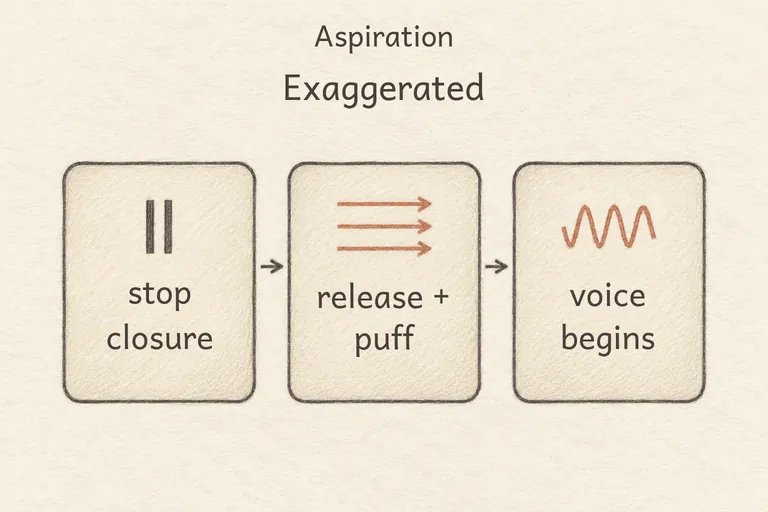
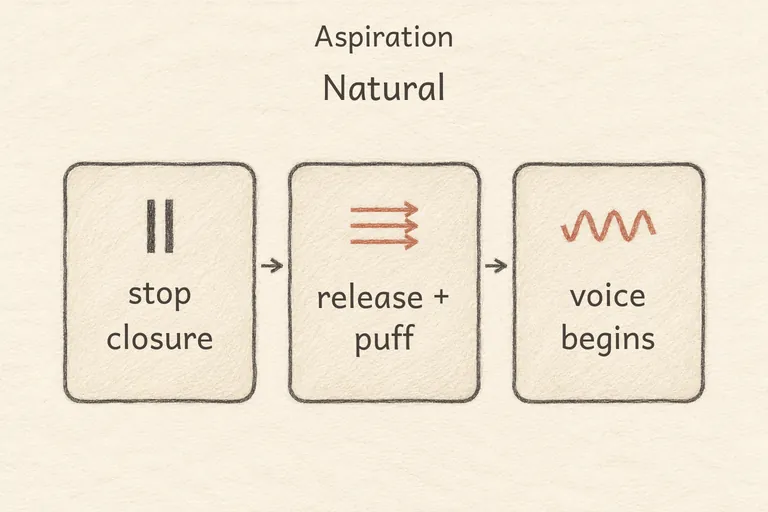
Why this works. Over-aspirating stops into an almost audible 'h' after the release lets the learner isolate and feel the glottal delay that produces aspiration, before scaling the airflow back down to a natural but still clearly aspirated level; this overshoot-then-reduce strategy mirrors training protocols where exaggerated acoustic contrasts sharpen perceptual categories prior to natural-level production.
Sources (1)
- Frontiers | The Role of Temporal Acoustic Exaggeration inHigh... — 2019
- The HVPT-E group showed superior improvement in natural word identification compared to the standard HVPT group.
- Temporal acoustic exaggeration promotes native-like categorical perception based on spectral cues in adult L2 learners.
- Training with temporal exaggeration induces measurable changes in pre-attentive neural processing (MMN responses).
Drill the Aspirated Onset
sourced- Say 'Peter poured the tea into two cups' slowly, pausing right after each p and t to add a small puff of air.
- Speed up gradually while keeping that puff audible on each stressed p/t.
- Say 'Kate's cat kept the key' the same way, adding a puff after each stressed k.
- Record both sentences at a natural conversational pace.
- Listen back and underline any stop that sounds like it's missing its puff of air.
- Redo just the underlined words with extra breath support.
Success check: You can clearly hear a short burst of air after every stressed p, t, and k in both sentences when played back.
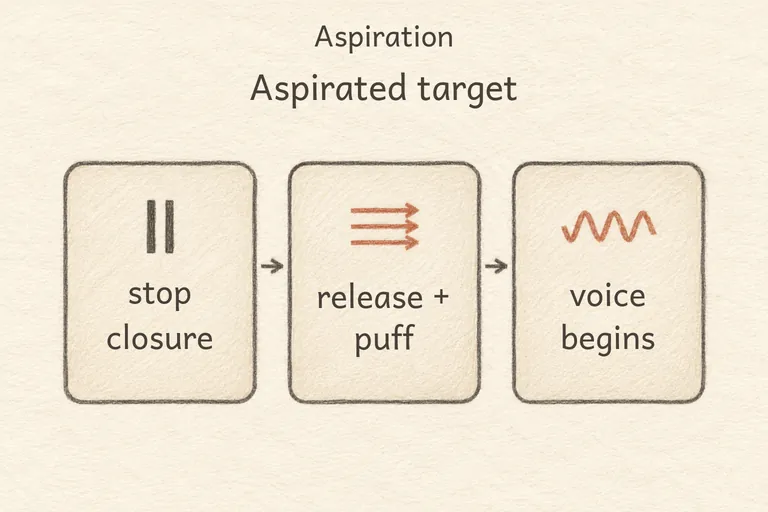
Why this works. A carrier sentence packed with multiple stressed p/t/k onsets lets the learner practice the aspiration gesture repeatedly within one breath group, building a motor habit of delaying voicing onset specifically in stressed-syllable-initial position while contrasting it with the unaspirated post-s environment.
Sources (1)
- Targeted Pronunciation Instruction in Multilingual Classrooms... — 2025
- Vowel contrast accuracy improved significantly from 62.5% to 78.3% in the targeted group, compared to only a 2.3% gain in the control group.
- Stress accuracy rose from 60.8% to 76.4% for learners receiving targeted instruction, with large effect sizes (d=1.48 for vowels, d=0.92 for stress).
- Qualitative data revealed that learners adopted durable strategies such as minimal pair drills and shadowing, leading to fewer real-world misunderstandings.
Shadow the Puff of Air
consensus- Listen to 'Peter poured the tea into two cups' once without speaking.
- Hold a strip of paper near your mouth and play the recording again, starting to shadow it a beat behind.
- Watch the paper move on 'Peter', 'poured', 'tea', and 'two', matching the model's timing.
- Record yourself shadowing the full sentence three times.
- Repeat the process with 'Kate's cat kept the key.'
- Compare your recording to the model and note any stops that lack a visible or audible puff.
Success check: The paper strip visibly flutters right after you release p, t, or k at the start of 'Peter', 'tea', 'two', 'Kate's', 'cat', 'kept', and 'key', timed with the recording.
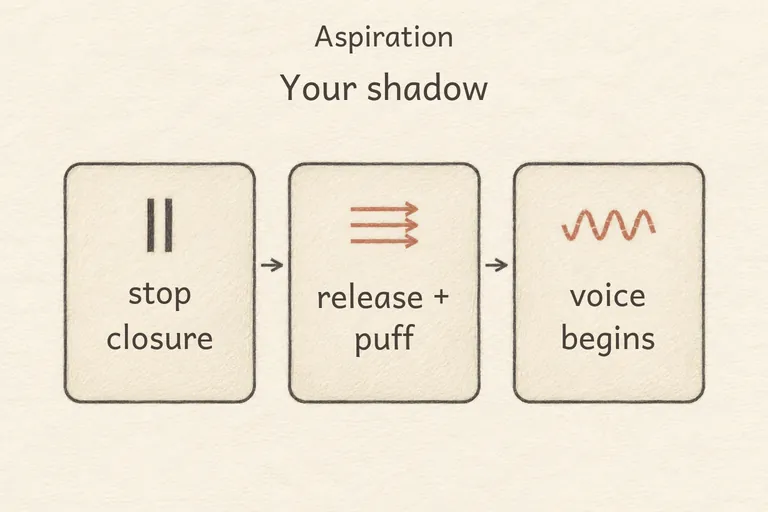
Why this works. Shadowing the model's stressed-syllable-initial stops in real time trains the release-to-voicing timing (voice onset time) needed for aspiration, since matching the model's exact release-to-voicing gap is only possible if the learner delays glottal closure the way English speakers do.
Sources (1)
- Wells, J.C. (1982). Accents of English.
Reader ratings and feedback are coming soon.
Sources (1)
- Prof John C. Wells_Workshop: Questions and Answers onEnglish...
- The content identifies core phonetic features relevant to accent analysis, including tonal patterns (High Fall, Fall-Rise) and articulatory phenomena (aspiration, clipping, glottal stop).
- It references John C. Wells' 'Accents of English' as the primary theoretical source for understanding English accent variation.
- The material targets early English teaching and learning contexts by highlighting specific tonicity and syllabification rules.