Flap t
You likely pronounce every English t between vowels as a full, crisp stop with a clear release, the same precise way Hungarian handles its t and d sounds, including in words like 'better' or 'water'.
What you probably do
You likely pronounce every English t between vowels as a full, crisp stop with a clear release, the same precise way Hungarian handles its t and d sounds, including in words like 'better' or 'water'.
How natives do it
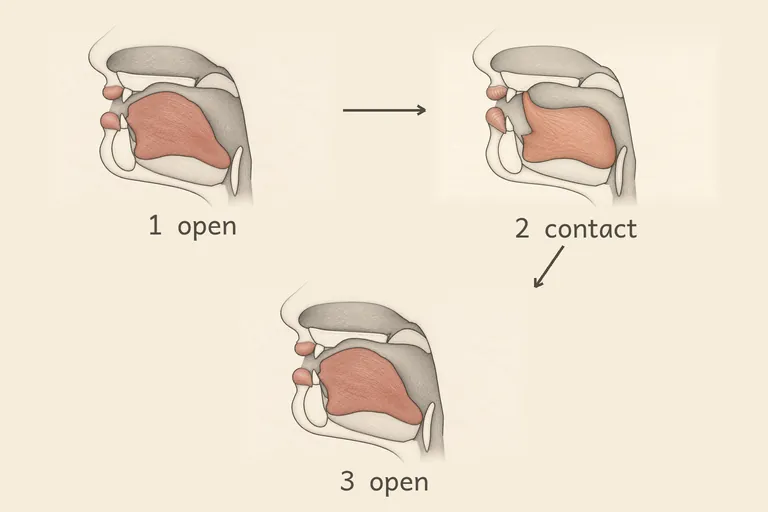
In casual American speech, that same t between vowels gets reduced to a very quick, light tap of the tongue against the ridge — so quick it can sound almost like a d — as in 'butter' or 'city'.
Why it matters
Using a fully released, crisp t in these positions isn't wrong, but it sounds noticeably formal or foreign in everyday American speech; learning the flap makes casual conversation sound smoother and more natural without changing meaning.
How the mouth differs
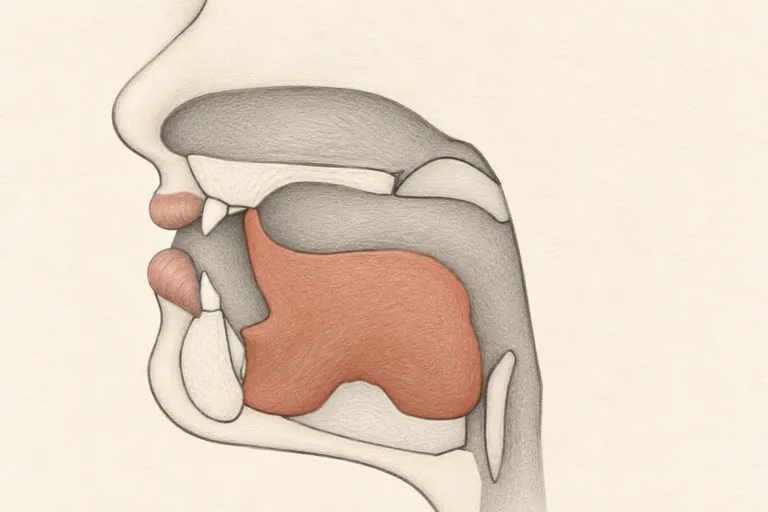
Hungarian /t/ and /d/ are produced as crisp, fully articulated stops in all positions, including between vowels, sometimes even lengthened as geminates. General American frequently reduces intervocalic /t/ and /d/ to a quick alveolar tap (flap), especially in casual connected speech, making words like 'butter' and 'water' sound almost like they contain a quick 'd' or light tap rather than a full stop.
Listen for the pattern
Pronouncing every intervocalic t as a fully released, crisp stop, as Hungarian habits encourage, makes English sound overly formal or slightly foreign, since Americans expect a softened, quick flap in words like 'better' and 'city' in everyday speech.
Try these sentences
- I'd better get some butter and water.Intervocalic t/d in 'better', 'butter', and 'water' become a quick tongue-tap in casual General American speech.
- What a pretty little city!The t's in 'pretty', 'little', and 'city' flap between vowels rather than staying a crisp, fully released stop.
Practise it
Overshoot the Tap, Then Lighten
sourced- Say 'butter' with the middle consonant sounding almost exactly like 'budder'.
- Repeat this exaggerated version three times, feeling the quick, loose tongue tap.
- Now say 'butter' again, lightening the tap slightly so it's not quite as 'd'-like.
- Say it one more time at a natural, comfortable speed.
- Repeat the whole sequence with 'water' and 'city'.
- Record your final natural versions and compare them to a native model.
Success check: Your natural version sounds like a quick, light tap — not a crisp held t, and not quite as voiced as your exaggerated 'd'-like practice version.
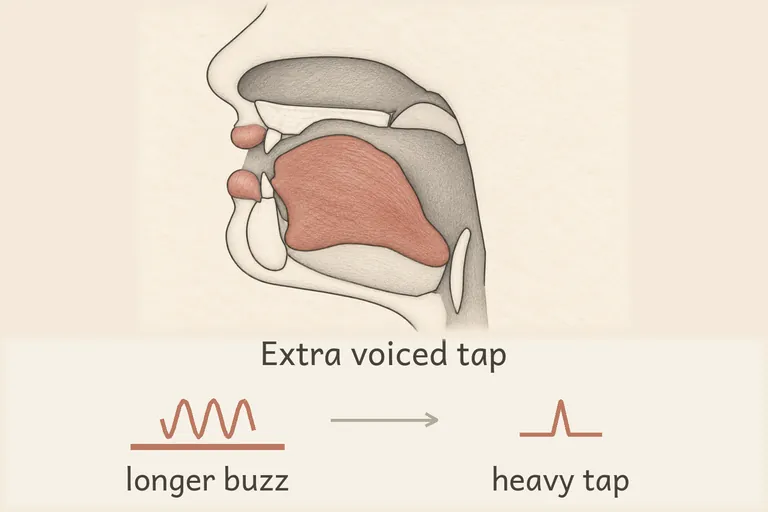
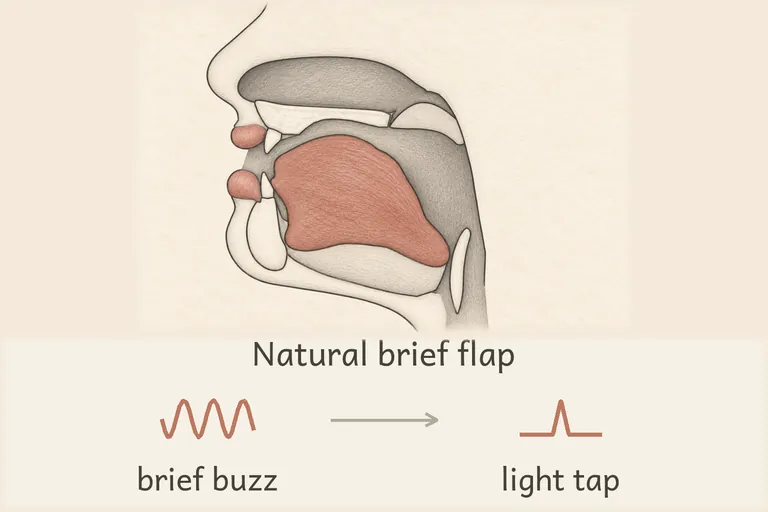
Why this works. Briefly over-voicing the flap so it sounds almost exactly like 'd' lets the learner feel the shortened, ballistic tongue-tip gesture in isolation before dialing it back toward the authentic, lighter flap; exaggerated acoustic contrast sharpens the learner's internal motor-perceptual target before fine-tuning to a natural variant.
Sources (1)
- The Role of Temporal Acoustic Exaggeration in High Variability Phonetic Training: A Behavioral and ERP Study — Bing Cheng, Xiaojuan Zhang, Siying Fan et al., 2019
- The HVPT-E group showed greater improvement in natural word identification performance compared to the standard HVPT group.
- Training with temporal acoustic exaggeration induced native-like categorical perception based on spectral cues.
- MMN responses demonstrated training-induced changes at pre-attentive neural levels, suggesting enhanced brain plasticity.
Drill the Light Tap
sourced- Read 'I'd better get some butter and water' slowly, saying each t as a full crisp stop first.
- Say it again, turning only the t's in 'better', 'butter', and 'water' into quick taps.
- Speed up to a natural conversational pace while keeping those taps light.
- Do the same two-step process with 'What a pretty little city!'.
- Record both sentences at natural speed.
- Listen back and circle any t that still sounds like a full, held stop.
- Redo just those words with extra-light, extra-fast tongue taps.
Success check: At natural speed, the t's between vowels sound like quick taps close to a fast 'd', not crisp held stops.
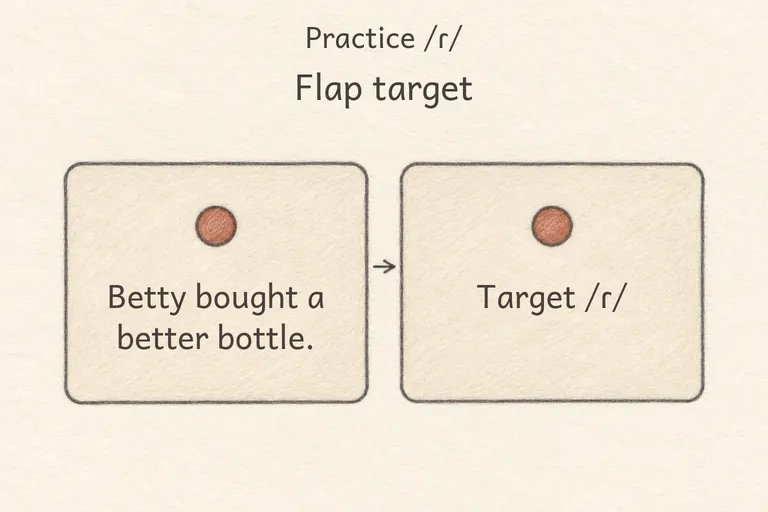
Why this works. Repeating a carrier sentence dense with intervocalic t/d gives multiple back-to-back opportunities to practice converting a full stop into a tap, letting the learner build consistent tongue-tip timing across several words in one breath group.
Sources (1)
- Targeted Pronunciation Instruction in Multilingual Classrooms... — 2025
- Vowel contrast accuracy improved significantly from 62.5% to 78.3% in the targeted group, compared to only a 2.3% gain in the control group.
- Stress accuracy rose from 60.8% to 76.4% for learners receiving targeted instruction, with large effect sizes (d=1.48 for vowels, d=0.92 for stress).
- Qualitative data revealed that learners adopted durable strategies such as minimal pair drills and shadowing, leading to fewer real-world misunderstandings.
Shadow the Quick Tap
consensus- Listen to the recording of 'I'd better get some butter and water' at normal speed.
- Play it again and start speaking a beat behind it, matching its speed exactly.
- Let the t's in 'better', 'butter', and 'water' turn into one quick, light tap rather than a crisp stop.
- Record your shadowed version.
- Compare your t sounds to the model's — they should sound almost like a fast 'd'.
- Repeat with 'What a pretty little city!' at the same brisk pace.
Success check: The t's in 'better', 'butter', 'water', 'pretty', 'little', and 'city' sound like one quick, soft tap rather than a held, crisp stop.
Why this works. Shadowing connected speech at natural speed forces the tongue tip to execute a single quick contact rather than a held stop, because the fast timing window of shadowing does not allow time for the longer closure duration typical of a fully released, Hungarian-style stop.
Sources (1)
- Wells, J.C. (1982). Accents of English.
Reader ratings and feedback are coming soon.
Sources (1)
- Wells, J.C. (1982). Accents of English.