Aspiration
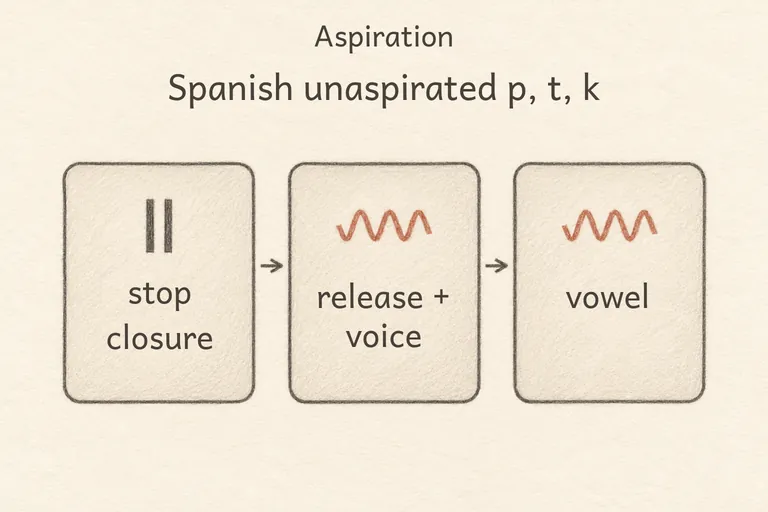
In Spanish, p, t, and k are always produced without any puff of air, whether at the start of a word or anywhere else — there's no contrast that depends on aspiration, only on voicing.
What you probably do
In Spanish, p, t, and k are always produced without any puff of air, whether at the start of a word or anywhere else — there's no contrast that depends on aspiration, only on voicing. Carrying this habit into English, you likely pronounce words like 'pie', 'tie', and 'kite' with a soft, unaspirated consonant, closer to how you would say them in 'pan', 'tango', or 'casa'.
How natives do it
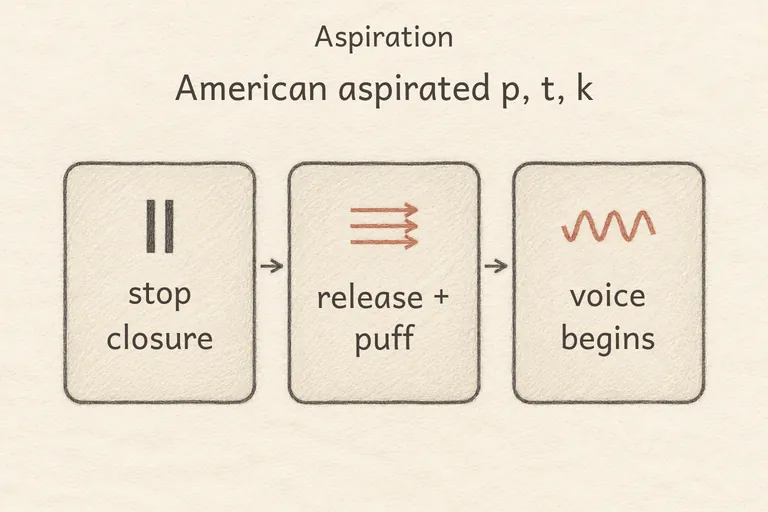
At the start of a stressed syllable, American English speakers release p, t, and k with a strong burst of air; hold a tissue near your mouth and it should visibly move. This aspiration is actually the main cue English listeners use to tell 'pie' from 'bye', 'tie' from 'die', and 'kite' from a word starting with g, even more than whether the vocal cords are vibrating.
Why it matters
Without that puff of air, your voiceless p, t, k can be misheard by native English listeners as the voiced b, d, g, since aspiration, not just voicing, signals the difference in English. This can cause real confusion between pairs like 'pie' and 'bye', even when everything else is clear. Adding a crisp puff of air to stressed initial p, t, and k is one of the highest-impact, easiest fixes available to a Spanish-speaking learner.
How the mouth differs
English voiceless stops p, t, k are produced with long-lag voice onset time, a strong 40 to 100 millisecond puff of air, at the start of stressed syllables, whereas Spanish p, t, k are always short-lag and unaspirated regardless of stress or position, since Spanish relies purely on a voicing contrast rather than aspiration to separate its stop consonants.
Listen for the pattern
Because English listeners use aspiration, not voicing, as the primary cue for the p-b, t-d, k-g distinctions in stressed syllable onsets, unaspirated Spanish-style stops are frequently misheard as their voiced counterparts, creating real word-level confusion rather than just an accent flavor.
Try these sentences
- Peter paid for the pizza.stressed initial p in 'Peter', 'paid', 'pizza' needs a strong puff of air; unaspirated Spanish-style p can sound like b
- Tom took two tickets.initial t sounds need aspiration in stressed position; without it, 'Tom' may be heard as 'Dom'
- Can you come to the park?stressed initial k in 'come', 'park' requires aspiration; unaspirated versions can be perceived as g
Practise it
Overshoot the Puff, Then Shrink It
sourced- Say 'Peter' with a huge, almost 'p-h-eter' puff of air after the first p.
- Repeat this exaggerated version three times, feeling the strong breath release.
- Say 'Peter' again with about half that amount of air.
- Say it once more at a natural, comfortable level, keeping a clear but shorter puff.
- Repeat the same three steps with 'tea' and 'key'.
- Record your final natural versions and check them against a model recording.
Success check: Your natural-level recording still has a clearly audible puff of air after p, t, and k, just smaller than your first exaggerated attempt.
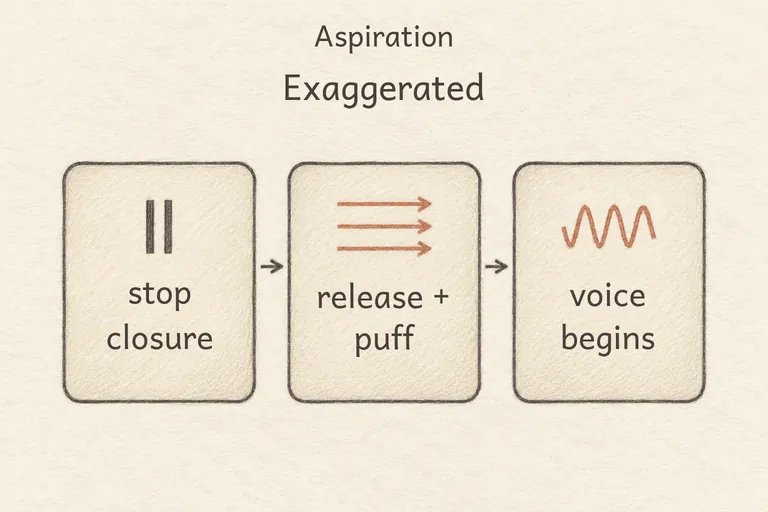
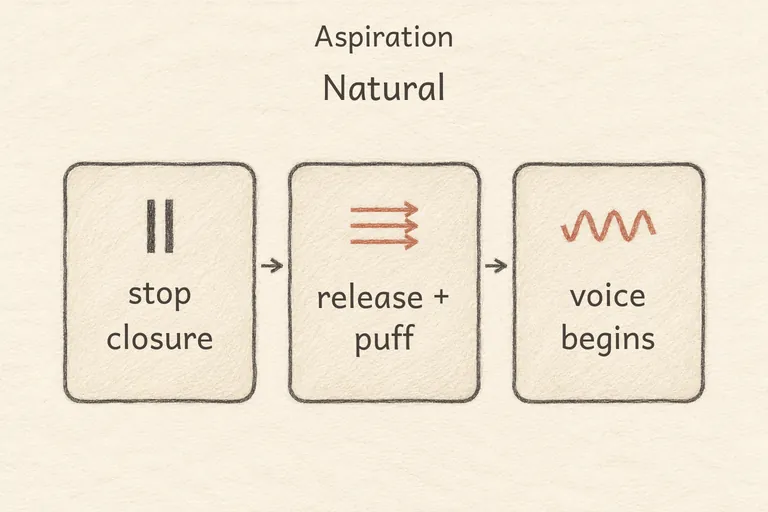
Why this works. Over-aspirating stops into an almost audible 'h' after the release lets the learner isolate and feel the glottal delay that produces aspiration, before scaling the airflow back down to a natural but still clearly aspirated level; this overshoot-then-reduce strategy mirrors training protocols where exaggerated acoustic contrasts sharpen perceptual categories prior to natural-level production.
Sources (1)
- Frontiers | The Role of Temporal Acoustic Exaggeration inHigh... — 2019
- The HVPT-E group showed superior improvement in natural word identification compared to the standard HVPT group.
- Temporal acoustic exaggeration promotes native-like categorical perception based on spectral cues in adult L2 learners.
- Training with temporal exaggeration induces measurable changes in pre-attentive neural processing (MMN responses).
Drill the Aspirated Onset
sourced- Say 'Peter poured the tea into two cups' slowly, pausing right after each p and t to add a small puff of air.
- Speed up gradually while keeping that puff audible on each stressed p/t.
- Say 'Kate's cat kept the key' the same way, adding a puff after each stressed k.
- Record both sentences at a natural conversational pace.
- Listen back and underline any stop that sounds like it's missing its puff of air.
- Redo just the underlined words with extra breath support.
Success check: You can clearly hear a short burst of air after every stressed p, t, and k in both sentences when played back.
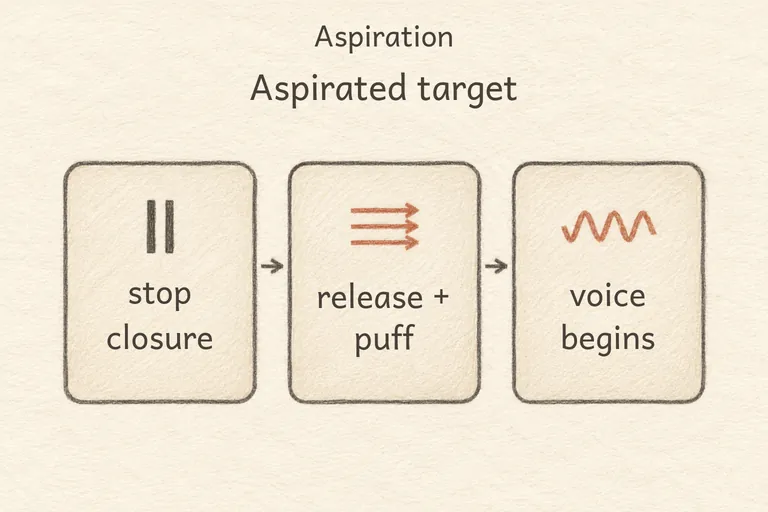
Why this works. A carrier sentence packed with multiple stressed p/t/k onsets lets the learner practice the aspiration gesture repeatedly within one breath group, building a motor habit of delaying voicing onset specifically in stressed-syllable-initial position while contrasting it with the unaspirated post-s environment.
Sources (1)
- Targeted Pronunciation Instruction in Multilingual Classrooms... — 2025
- Vowel contrast accuracy improved significantly from 62.5% to 78.3% in the targeted group, compared to only a 2.3% gain in the control group.
- Stress accuracy rose from 60.8% to 76.4% for learners receiving targeted instruction, with large effect sizes (d=1.48 for vowels, d=0.92 for stress).
- Qualitative data revealed that learners adopted durable strategies such as minimal pair drills and shadowing, leading to fewer real-world misunderstandings.
Shadow the Puff of Air
consensus- Listen to 'Peter poured the tea into two cups' once without speaking.
- Hold a strip of paper near your mouth and play the recording again, starting to shadow it a beat behind.
- Watch the paper move on 'Peter', 'poured', 'tea', and 'two', matching the model's timing.
- Record yourself shadowing the full sentence three times.
- Repeat the process with 'Kate's cat kept the key.'
- Compare your recording to the model and note any stops that lack a visible or audible puff.
Success check: The paper strip visibly flutters right after you release p, t, or k at the start of 'Peter', 'tea', 'two', 'Kate's', 'cat', 'kept', and 'key', timed with the recording.
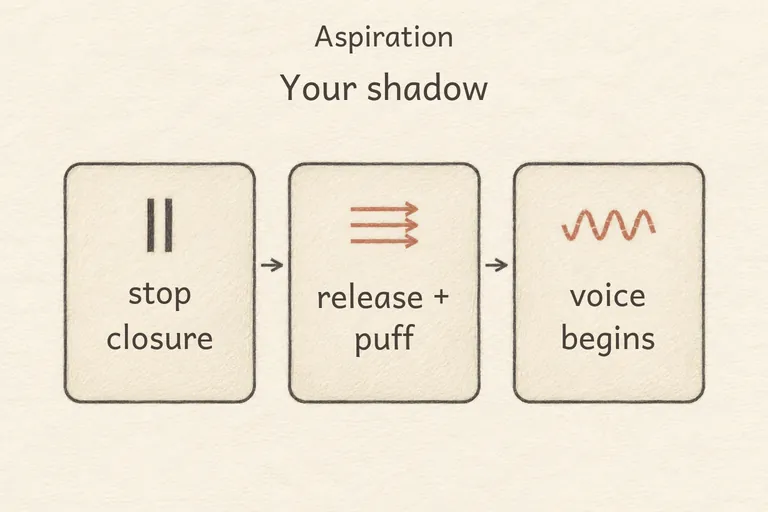
Why this works. Shadowing the model's stressed-syllable-initial stops in real time trains the release-to-voicing timing (voice onset time) needed for aspiration, since matching the model's exact release-to-voicing gap is only possible if the learner delays glottal closure the way English speakers do.
Sources (1)
- Wells, J.C. (1982). Accents of English.
Reader ratings and feedback are coming soon.
Sources (2)
- Hualde, J.I. (2005). The Sounds of Spanish. Cambridge University Press.
- Wells, J.C. (1982). Accents of English.