Yes/no question intonation
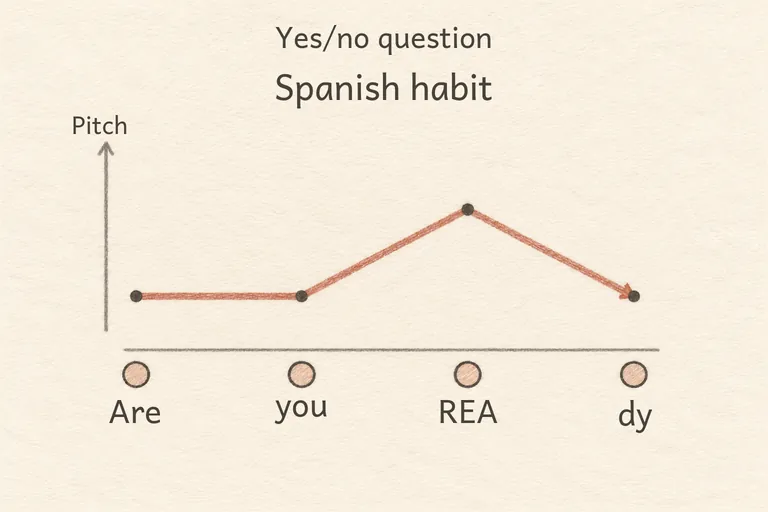
You may let your pitch rise across the sentence but then dip or fall slightly right at the very end, following a common Spanish rise-fall pattern for yes/no questions.
What you probably do
You may let your pitch rise across the sentence but then dip or fall slightly right at the very end, following a common Spanish rise-fall pattern for yes/no questions.
How natives do it
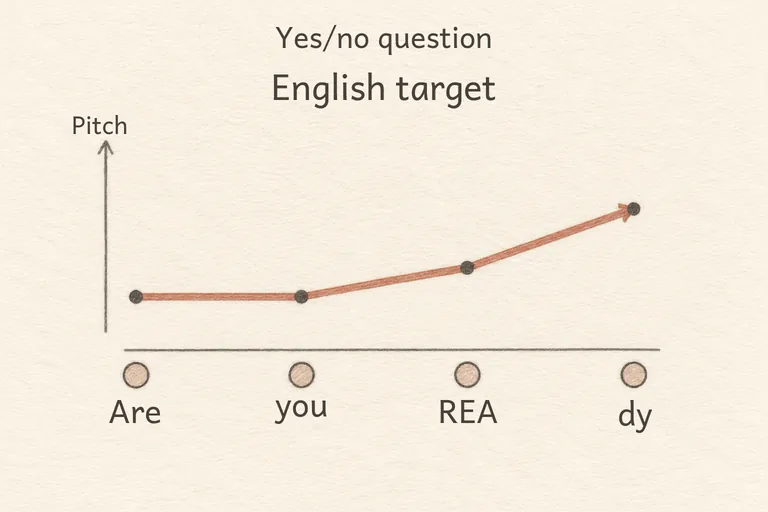
Americans keep the pitch climbing continuously through the last stressed syllable of the question and hold it high at the very end, without any closing fall back down.
Why it matters
A falling tail can make your question sound like it's turning into a statement, which sometimes causes listeners to miss that you were actually asking something and to wait for you to continue instead of answering.
How the mouth differs
Spanish yes/no questions often rise across the sentence and then fall slightly at the very end (or rise steadily in some varieties), while General American English typically rises continuously through the final stressed syllable and stays high, without the closing fall Spanish tends to add.
Listen for the pattern
Adding a small final fall, as Spanish intonation habits suggest, can make an English yes/no question sound like it's turning into a statement partway through, occasionally leaving listeners unsure whether a real question was being asked.
Try these sentences
- Are you coming to the party?pitch rises steadily and keeps climbing through 'PARty', ending noticeably high
- Did you finish the report?pitch stays relatively level until it rises sharply on the final stressed syllable 'rePORT'
Practise it
Overshoot the Rise, Then Settle
sourced- Say 'Are you coming to the party?' and deliberately rise your pitch on 'party' far higher than feels normal, almost cartoonishly high.
- Repeat the sentence three times, keeping the exaggerated high rise each time.
- Now say it again, bringing the rise down to about 70% of that exaggerated height.
- Say it one more time at a comfortable, natural-sounding rise, keeping the same upward direction.
- Record the natural version and compare it to a model recording.
- Repeat the whole sequence with 'Did you finish the report?'.
Success check: Your final, natural-sounding version still has a clear upward pitch movement on the last syllable, not a fall, even though it's less extreme than your first exaggerated attempt.
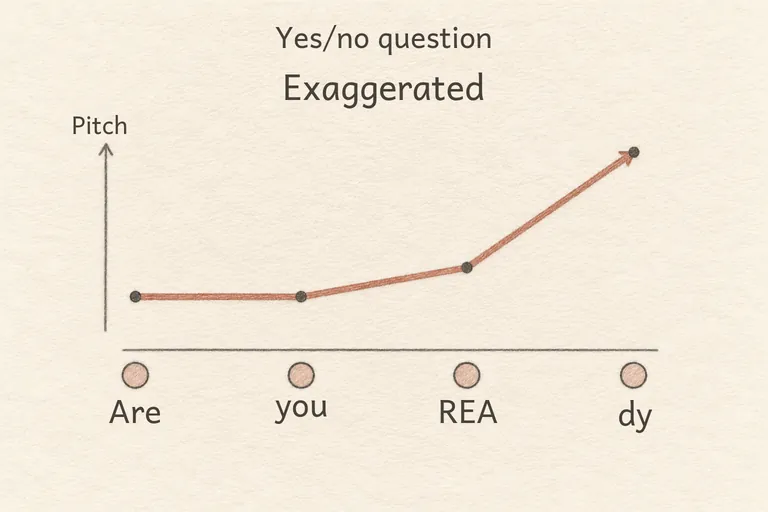
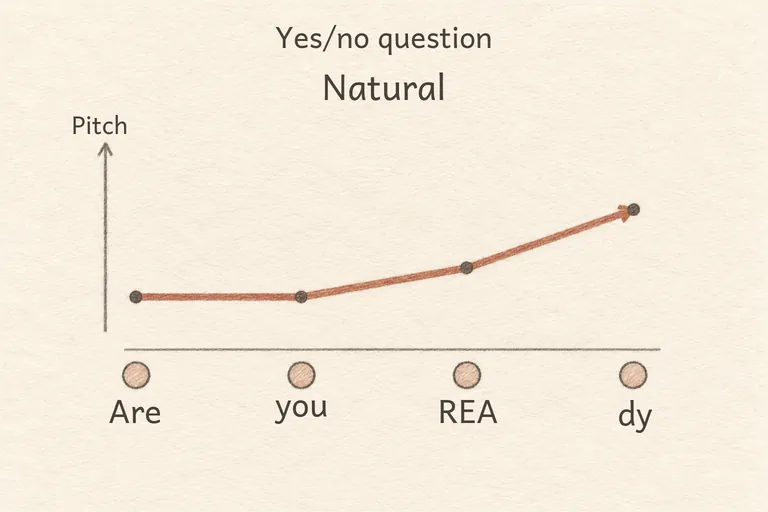
Why this works. Deliberately overshooting the final rise first lets the learner physically experience the full range of the target contour; research on temporal and acoustic exaggeration in phonetic training shows over-articulated contrasts create a clearer internal perceptual-motor category before the learner dials the movement back down to a natural, conversational rise.
Sources (1)
- The Role of Temporal Acoustic Exaggeration in High Variability Phonetic Training: A Behavioral and ERP Study — Bing Cheng, Xiaojuan Zhang, Siying Fan et al., 2019
- The HVPT-E group showed greater improvement in natural word identification performance compared to the standard HVPT group.
- Training with temporal acoustic exaggeration induced native-like categorical perception based on spectral cues.
- MMN responses demonstrated training-induced changes at pre-attentive neural levels, suggesting enhanced brain plasticity.
Drill the Final Rise
sourced- Read the sentence silently and find the stressed word near the end.
- Say 'Are you coming to the party?' aloud, letting pitch rise continuously from 'coming' to 'party'.
- Say 'Did you finish the report?' the same way, rising all the way through 'report'.
- Add two more yes/no questions of your own and apply the same rising shape.
- Record all four sentences in one take.
- Listen back and mark any sentence where your pitch falls before the very last syllable.
- Redo only the marked sentences, exaggerating the rise slightly to correct it.
Success check: Every sentence on your recording ends on an audibly higher pitch than the syllable before it, with no late fall.
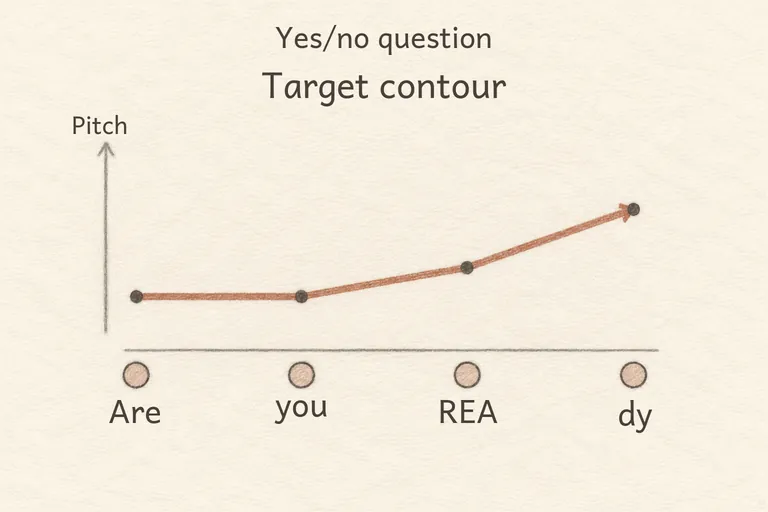
Why this works. Repeating a fixed set of carrier sentences that are all yes/no questions lets the learner isolate the sentence-final rising contour as the only variable, building a stable motor-pitch routine through repetition before testing it on multiple sentences in the same session.
Sources (1)
- Targeted Pronunciation Instruction in Multilingual Classrooms... — 2025
- Vowel contrast accuracy improved significantly from 62.5% to 78.3% in the targeted group, compared to only a 2.3% gain in the control group.
- Stress accuracy rose from 60.8% to 76.4% for learners receiving targeted instruction, with large effect sizes (d=1.48 for vowels, d=0.92 for stress).
- Qualitative data revealed that learners adopted durable strategies such as minimal pair drills and shadowing, leading to fewer real-world misunderstandings.
Shadow the Rising Question Tune
sourced- Play the recording of 'Are you coming to the party?' once through without speaking.
- Play it again and start speaking about half a second behind the recording, copying its pitch as closely as you can.
- Let your voice keep climbing through 'party' instead of dropping at the very end.
- Record yourself shadowing the sentence three times in a row.
- Play your recording back next to the original and check whether your final pitch drops or keeps rising.
- Repeat with 'Did you finish the report?', focusing only on matching the rising finish.
Success check: Your recorded voice should still be climbing in pitch on the very last syllable, with no downward dip at the end, closely overlapping the model's contour.
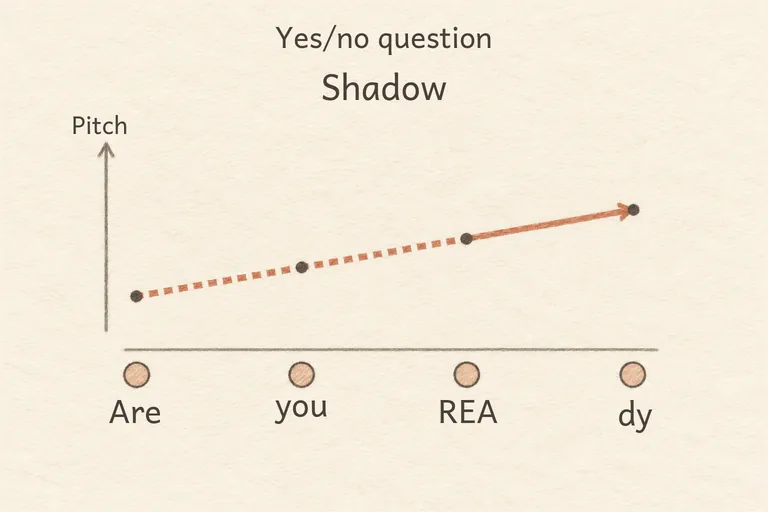
Why this works. Shadowing requires near-simultaneous reproduction of the model's pitch trajectory, forcing the learner's prosodic planning to lock onto the continuous rising F0 contour of English yes/no questions instead of defaulting to the L1 rise-fall template; the tight timing window suppresses conscious override of entrenched L1 intonation routines.
Sources (1)
- Effects of prosody awareness training on the intelligibility of Iranian interpreter trainees in English — Mahmood Yenkimaleki, Vincent J. van Heuven, 2019
- Prosody awareness training led to a significant improvement in the speech intelligibility of Iranian interpreter trainees.
- The experimental group, which received explicit instruction on English prosodic features, outperformed the control group that only consumed authentic media.
- Intelligibility ratings increased after the intervention period for participants receiving prosody-focused training.
Reader ratings and feedback are coming soon.
Sources (2)
- Wells, J.C. (1982). Accents of English.
- Hualde, J.I. (2005). The Sounds of Spanish. Cambridge University Press.