Word stress
You likely give each syllable fairly similar weight, with only a small boost on the stressed one, and you may not realize that stress can shift the meaning or grammatical role of a word, as it does between the noun and…
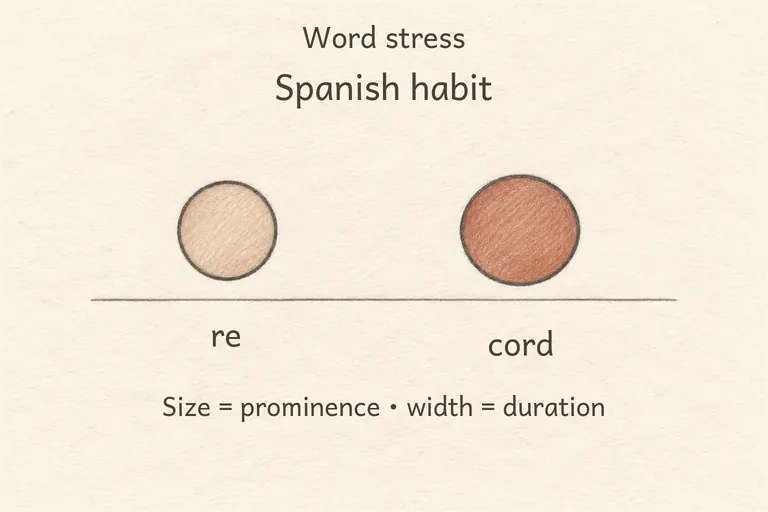
What you probably do
You likely give each syllable fairly similar weight, with only a small boost on the stressed one, and you may not realize that stress can shift the meaning or grammatical role of a word, as it does between the noun and verb forms of 'record'.
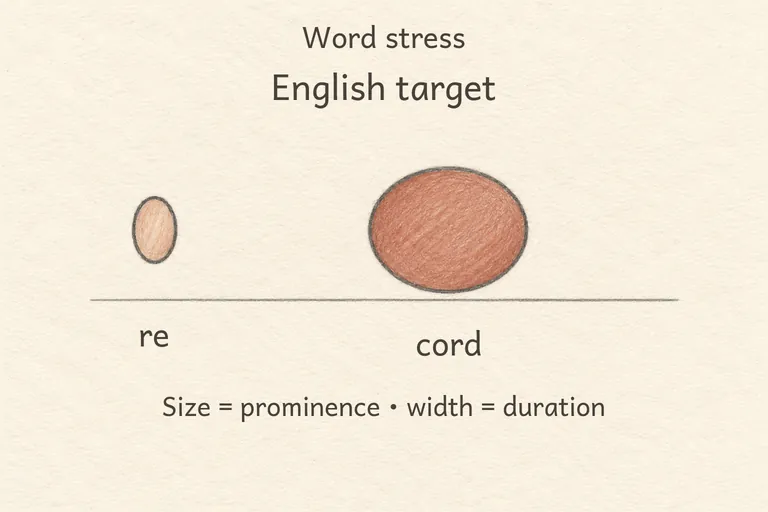
How natives do it
Americans make the stressed syllable dramatically louder, longer, and more dynamic in pitch than its neighbors, and they learn stress patterns word by word, including how stress moves when suffixes like '-tion' or '-ic' are added to a root.
Why it matters
Because English relies so heavily on stress contrast to signal word identity and grammatical category, flattening it can make your speech harder to parse quickly, even when every individual sound is pronounced correctly.
How the mouth differs
Spanish stress placement is largely regular and only mildly marked (louder, slightly longer), while English stress is lexical, unpredictable from spelling alone, and shifts dramatically within word families depending on suffixes, with the stressed syllable receiving strong pitch, length, and loudness prominence.
Listen for the pattern
Misplaced or under-marked stress is one of the fastest cues native listeners use to detect a non-native accent, and in extreme cases (like confusing noun/verb stress pairs such as record/record) it can momentarily obscure which meaning or part of speech is intended.
Try these sentences
- I need to record the record before the meeting.verb 'record' stressed on the second syllable (reCORD), noun 'record' stressed on the first (REcord)
- The photographer studies photography, not just photographs.stress shifts across the word family: PHOtograph, phoTOGraphy, photoGRAPHic
- She's an important and impressive photographer.'important' stresses the second syllable (imPORtant); Spanish cognates or spelling can tempt learners toward even, flatter stress
Practise it
Drill Sentence: Stress Shifts Everywhere
sourced- Read this sentence once silently: 'Can you record the meeting so we can play the record later?'
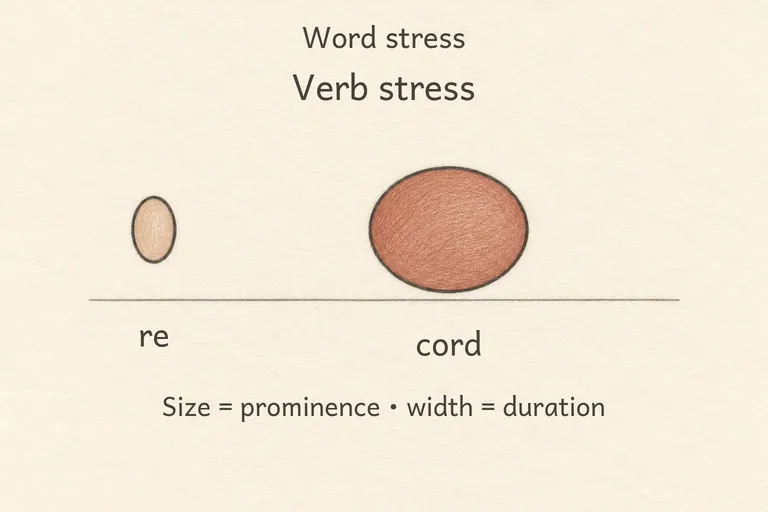
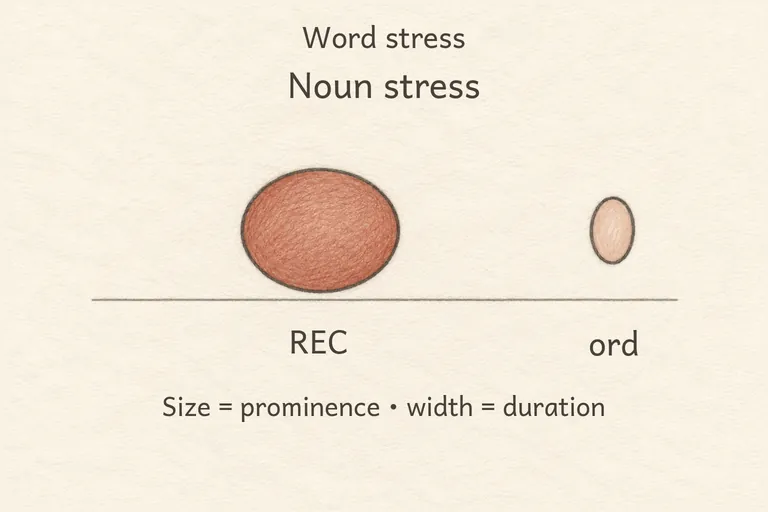
- Mark the stressed syllable in each instance of 'record': re-CORD (verb) vs. REC-ord (noun).
- Say the sentence very slowly, clearly stressing the second syllable in the verb and the first syllable in the noun.
- Record yourself reading the full sentence at a normal pace.
- Play it back and check that the two instances of 'record' sound noticeably different in rhythm, not identical.
- Repeat the sentence five times, trying to make the stress shift automatic rather than something you think about.
Success check: A listener can tell, just from your stress pattern, which 'record' is the verb and which is the noun — even with their eyes closed.
Why this works. Drilling a sentence containing noun/verb stress-shift pairs forces the learner to apply lexical stress knowledge productively and under time pressure within connected speech, rather than only recognizing it in isolated word lists. Explicit prosody-focused training of this kind has been shown to produce significant intelligibility gains compared to media exposure alone.
Sources (1)
- Effects of prosody awareness training on the intelligibility of Iranian interpreter trainees in English — Mahmood Yenkimaleki, Vincent J. van Heuven, 2019
- Prosody awareness training led to a significant improvement in the speech intelligibility of Iranian interpreter trainees.
- The experimental group, which received explicit instruction on English prosodic features, outperformed the control group that only consumed authentic media.
- Intelligibility ratings increased after the intervention period for participants receiving prosody-focused training.
Exaggerate the Beat, Then Dial It Back
sourced- Pick a multisyllabic word you tend to flatten, like 'banana' or 'computer'.
- Say it with an absurdly exaggerated stress: make the stressed syllable much louder, much higher in pitch, and much longer than usual — ba-NAAAA-na.
- Say it again, shrinking the unstressed syllables down to almost a whisper while keeping the stressed syllable huge.
- Record this exaggerated version.
- Repeat the word three more times, each time bringing the exaggeration down by about a third, until you reach a natural conversational level.
- Apply the same process to 'enjoy', 'photographer', and 'important'.
- Record your final, natural-sounding versions and compare them to your very first exaggerated attempt.
Success check: In your natural-speed recording, the stressed syllable is still clearly louder, longer, and higher-pitched than its neighbors — the exaggeration training left a permanent, audible trace even after dialing it back.
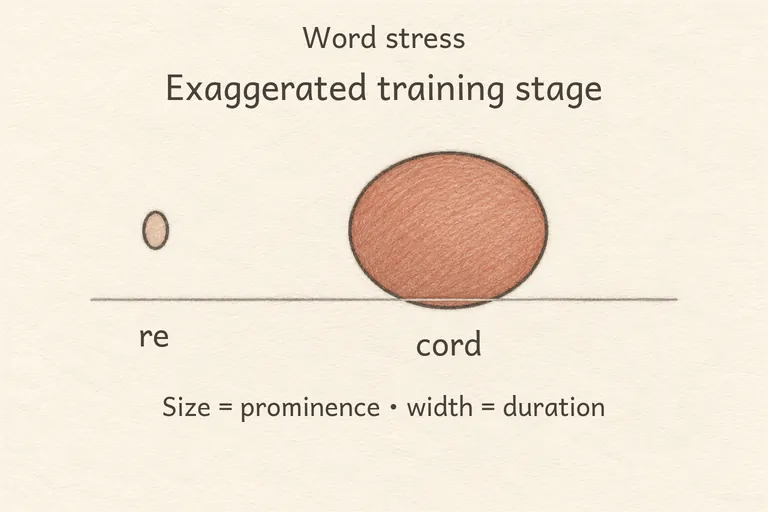
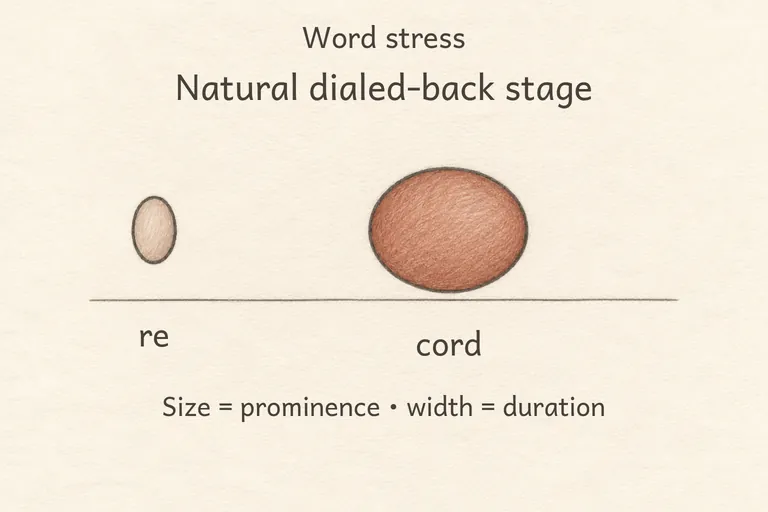
Why this works. Overshooting the loudness, pitch, and length of the stressed syllable before gradually shrinking the exaggeration back to natural levels strengthens the learner's internal category for 'stressed vs. unstressed,' since training with exaggerated acoustic cues has been shown to induce more native-like categorical processing that persists once the exaggeration fades.
Sources (1)
- Frontiers | The Role of Temporal Acoustic Exaggeration inHigh... — 2019
- The HVPT-E group showed superior improvement in natural word identification compared to the standard HVPT group.
- Temporal acoustic exaggeration promotes native-like categorical perception based on spectral cues in adult L2 learners.
- Training with temporal exaggeration induces measurable changes in pre-attentive neural processing (MMN responses).
Shadow the Stress Pattern, Not Just the Words
sourced- Find a short recording of a native speaker saying: 'She's a photographer, not a photograph collector.'
- Listen once all the way through without speaking.
- Play it again, and this time speak along at the exact same time, matching not the words but the ups and downs of loudness and pitch.
- Pause after each sentence and exaggerate the stressed syllables even more than the recording did: PHO-to-GRA-pher.
- Shadow the sentence three more times, gradually matching the recording's natural rhythm instead of your exaggerated version.
- Record your own final shadowed attempt.
- Compare your recording to the original, syllable by syllable, checking that your stressed syllables are louder, longer, and higher-pitched than your unstressed ones.
Success check: Your shadowed recording has the same 'tall and short' rhythm as the original, with clearly stronger syllables exactly where the native speaker put them — not an even beat on every syllable.
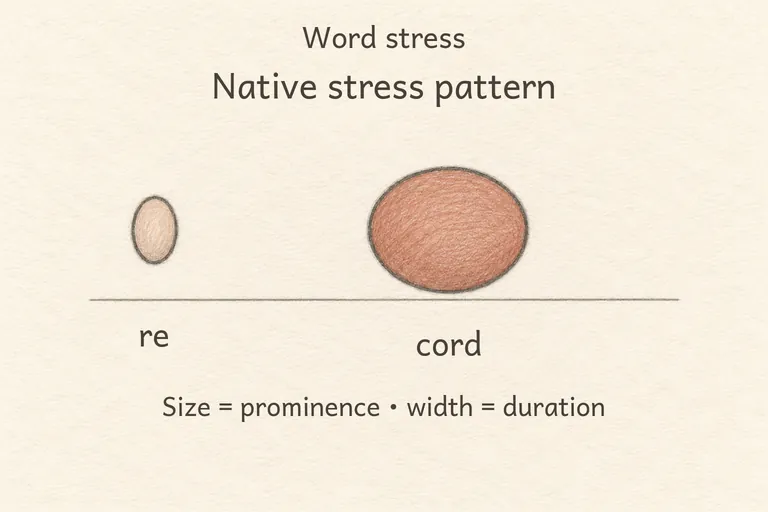
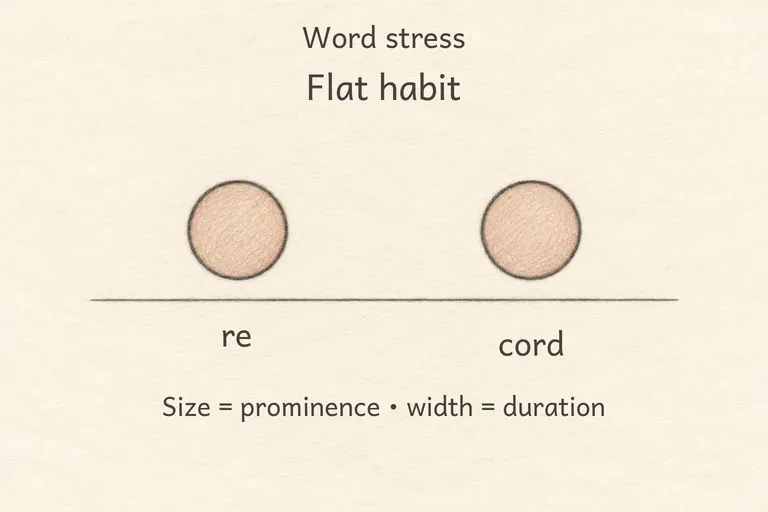
Why this works. Shadowing trains simultaneous reproduction of a native speaker's loudness, pitch, and duration patterns, which are the acoustic correlates of lexical stress that fixed-stress L1 habits do not provide practice with. Learners who adopted shadowing alongside minimal-pair drills as part of targeted instruction showed durable gains in stress accuracy and fewer real-world misunderstandings.
Sources (1)
- Targeted Pronunciation Instruction in Multilingual Classrooms... — 2025
- Vowel contrast accuracy improved significantly from 62.5% to 78.3% in the targeted group, compared to only a 2.3% gain in the control group.
- Stress accuracy rose from 60.8% to 76.4% for learners receiving targeted instruction, with large effect sizes (d=1.48 for vowels, d=0.92 for stress).
- Qualitative data revealed that learners adopted durable strategies such as minimal pair drills and shadowing, leading to fewer real-world misunderstandings.
Reader ratings and feedback are coming soon.
Sources (2)
- Wells, J.C. (1982). Accents of English.
- Hualde, J.I. (2005). The Sounds of Spanish. Cambridge University Press.