/s/as in sun
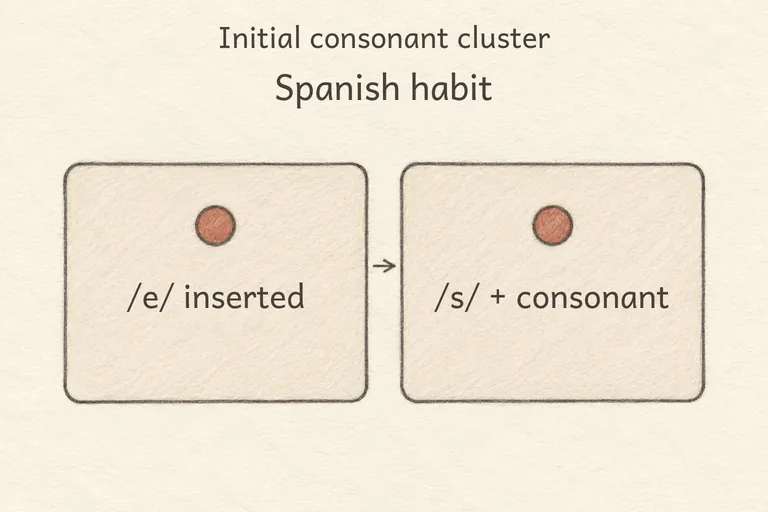
Because Spanish never allows a word to start with 's' followed directly by another consonant, you probably insert a brief 'e' sound before English words like 'school', 'state', or 'Spain', the same way Spanish handles…

What you probably do
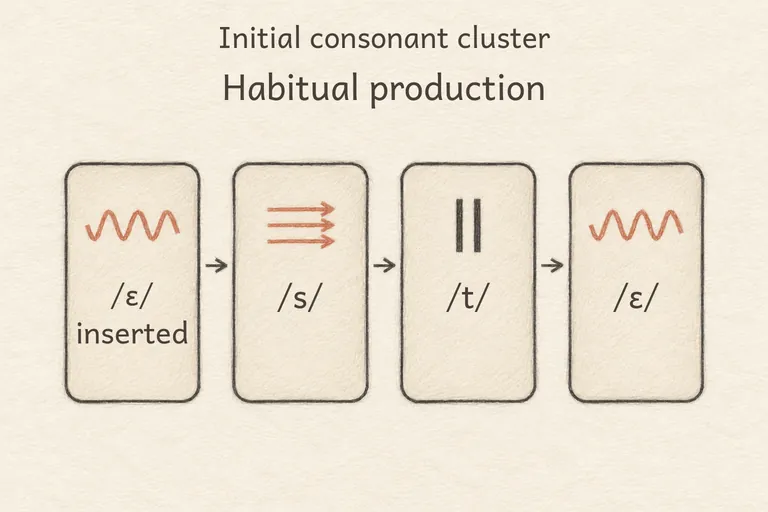
Because Spanish never allows a word to start with 's' followed directly by another consonant, you probably insert a brief 'e' sound before English words like 'school', 'state', or 'Spain', the same way Spanish handles borrowed words like 'estudiante', turning a one-syllable English word into two syllables without realizing it.
How natives do it
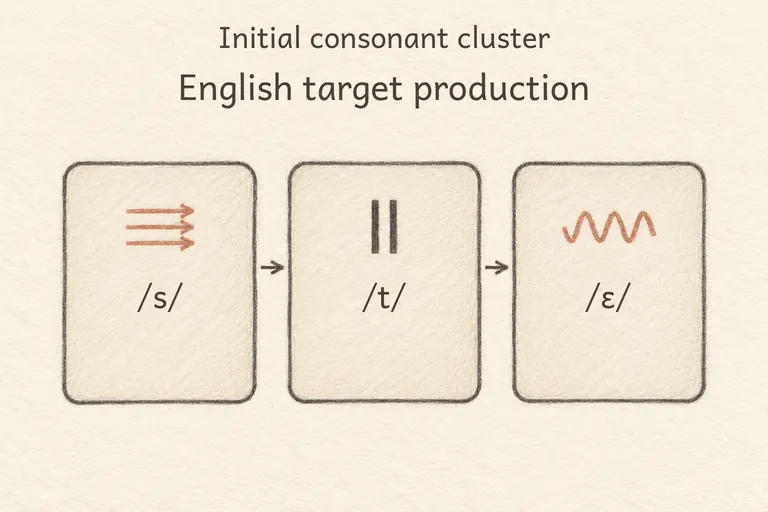
Americans start these words directly on the 's' sound with no vowel before it at all — 'school' begins immediately with a hissing 's' followed by 'k', with the tongue and lips moving straight into the cluster rather than easing into it with a vowel first.
Why it matters
This added syllable disrupts the stress-timed rhythm that English relies on and, in some cases, can make your pronunciation sound exactly like a different real word — turning 'state' into 'estate' or 'spy' into 'espy' — so learning to start directly on 's' is a high-value, easy-to-practice fix.
Hear the difference
Words this touches
Spanish speakers often substitute /s, es/.
How the mouth differs
The s segment itself is articulated almost identically in both languages, but Spanish phonotactics never allow a word to begin with s plus another consonant; any such cluster is preceded by an epenthetic e-vowel. Speakers transfer this pattern into English, inserting a brief vowel before initial s-clusters like 'sp', 'st', and 'sk', turning one-syllable words like 'school' or 'state' into two syllables.
Listen for the pattern
The inserted vowel adds an extra syllable that disrupts English stress-timed rhythm and can make words genuinely harder to recognize quickly, and in a few cases can make the mispronunciation sound exactly like a different, existing English word, such as 'estate' instead of 'state'.
Practise it
Exaggerate the Hiss: No Vowel Before 's'
sourced- Say 'state' and deliberately hold the very first 's' sound for two to three seconds, like a long hiss, before moving into the rest of the word.
- Notice that during that long hiss, no vowel sound ever appears — your mouth stays in the 's' position the whole time.
- Repeat this exaggerated, long-hiss version three times for 'state', 'spy', and 'strange'.
- Gradually shorten the hiss by about half, still keeping zero vowel before it.
- Shorten it once more until the 's' duration feels natural but you still clearly remember there's no vowel before it.
- Record yourself saying all three words at this natural duration.
- Play back the recording and confirm each word has exactly one syllable with no vowel before the 's'.
Success check: Your final recordings should show no vowel before the 's' in any of the three words, and each word should contain exactly one syllable at natural speaking speed.
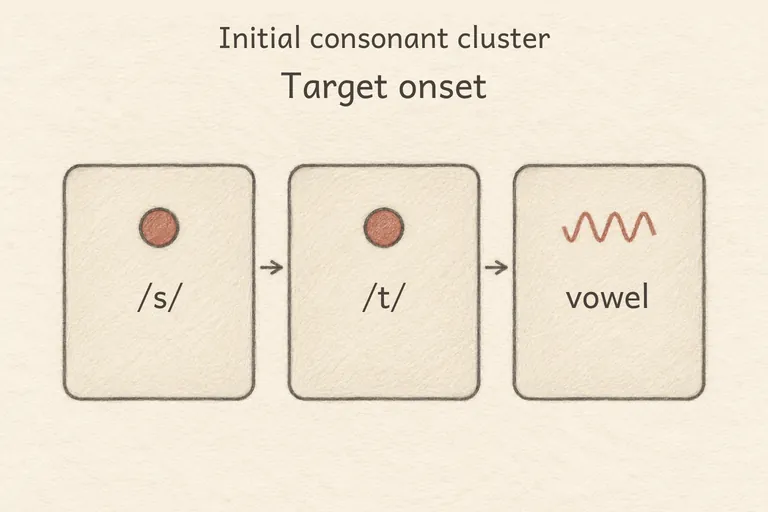
Why this works. Deliberately over-prolonging the 's' hiss at the very start of the word, with an exaggeratedly abrupt, vowel-free onset, then gradually shortening it to normal duration, gives learners a clear perceptual and motor landmark for 'no vowel before the cluster,' consistent with exaggerated-contrast training improving categorical learning before fading to natural production.
Sources (2)
- Distinguishing universal and language-dependent levels of speech perception: Evidence from Japanese listeners' perception of English “l” and “r” — Virginia A. Mann, 1986
- Japanese listeners successfully discriminate the acoustic properties of English /l/ and /r/ when presented with non-English contrasts, ruling out a universal hearing deficit.
- The primary source of error is language-dependent categorization, where listeners map English sounds onto their existing L1 phonological categories (e.g., classifying both as liquids).
- Performance improves significantly when the acoustic contrast between /l/ and /r/ is exaggerated or presented in contexts that highlight their distinctiveness.
- The Role of Temporal Acoustic Exaggeration in High Variability Phonetic Training: A Behavioral and ERP Study — Bing Cheng, Xiaojuan Zhang, Siying Fan et al., 2019
- The HVPT-E group showed greater improvement in natural word identification performance compared to the standard HVPT group.
- Training with temporal acoustic exaggeration induced native-like categorical perception based on spectral cues.
- MMN responses demonstrated training-induced changes at pre-attentive neural levels, suggesting enhanced brain plasticity.
Hear It: state vs estate
sourced- Listen to a recording of the pair 'state' and 'estate' without looking at the spelling.
- Count how many syllables you hear in each word.
- Write down which one you think has the extra vowel at the start.
- Replay both words slowly, listening specifically for any sound before the 's'.
- Repeat the exercise with 'spy/espy' and 'strange/estrange'.
- Check your answers and replay any pair you got wrong three times in a row.
- Finish by listening to all three pairs mixed in random order and identifying each correctly.
Success check: You should correctly identify whether each word has an extra vowel before the 's' cluster on at least 5 of 6 attempts, clearly hearing the syllable-count difference.
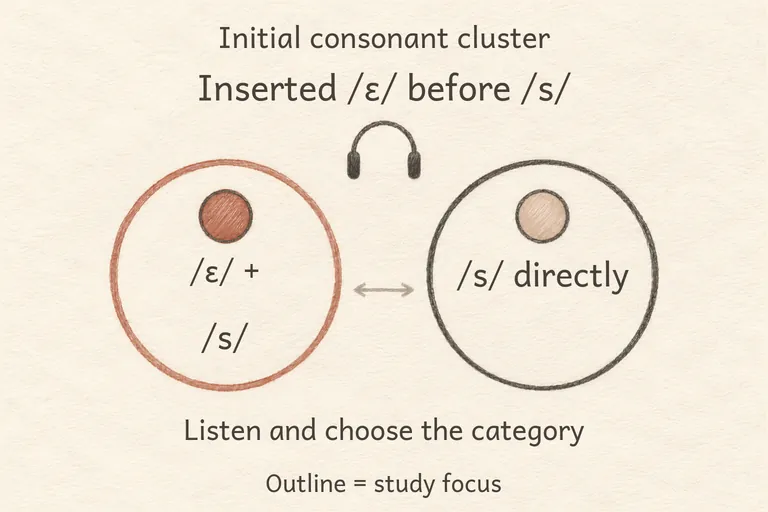
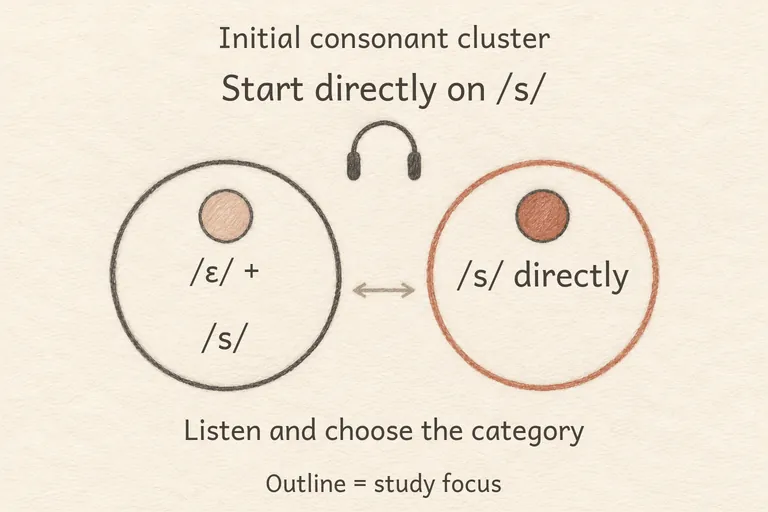
Why this works. Training learners to detect the presence or absence of an epenthetic vowel before word-initial s-clusters sharpens awareness of a phonotactic habit that is otherwise automatic and hard to self-monitor; discrimination training on minimal contrasts strengthens the perceptual category needed before production changes.
Sources (1)
- Distinguishing universal and language-dependent levels of speech perception: Evidence from Japanese listeners' perception of English “l” and “r” — Virginia A. Mann, 1986
- Japanese listeners successfully discriminate the acoustic properties of English /l/ and /r/ when presented with non-English contrasts, ruling out a universal hearing deficit.
- The primary source of error is language-dependent categorization, where listeners map English sounds onto their existing L1 phonological categories (e.g., classifying both as liquids).
- Performance improves significantly when the acoustic contrast between /l/ and /r/ is exaggerated or presented in contexts that highlight their distinctiveness.
Drill Sentence: Students in Spain Study Statistics
consensus- Read this sentence silently: 'Students in Spain study strange state statistics at school.'
- Underline every word that starts with 's' plus another consonant: students, Spain, study, strange, state, statistics, school.
- Say the sentence very slowly, starting each underlined word directly on the 's' with no vowel before it.
- Record yourself reading the sentence at this slow pace.
- Play it back and count the syllables in each underlined word, confirming none have an extra one.
- Repeat the sentence three more times, gradually increasing your speed toward normal conversational pace.
- Do a final recording at natural speed and verify every underlined word still begins directly on 's'.
Success check: In your final recording, every underlined word should begin directly on the 's' sound with no extra syllable, even at natural conversational speed.
Why this works. Reading a connected sentence dense with word-initial s-clusters under natural speech rate trains the learner to suppress the epenthetic vowel consistently across multiple words in a row, which is more demanding and more representative of real speech than isolated word practice.
Sources (1)
- Wells, J.C. (1982). Accents of English.
Say It Right: state, not estate
consensus- Say the habitual version first: 'estate', noticing the little vowel before the 's'.
- Now try to start the word with your lips and tongue already in position for 's', before any sound comes out.
- Push air through that 's' position immediately, moving straight into 'state' with no vowel in front.
- Record yourself saying 'state' and play it back to check for one syllable, not two.
- Repeat the same process with 'spy' and 'strange', starting directly on the cluster each time.
- Say all three words five times each, always beginning the mouth already in the consonant position.
- Have a listener (or app) confirm your words sound like one-syllable 'state', 'spy', 'strange', not two-syllable versions.
Success check: Your recordings should contain exactly one syllable for 'state', 'spy', and 'strange', with no audible vowel sound before the initial 's'.
Why this works. Producing the contrastive pairs forces the learner to inhibit the automatic epenthetic-vowel reflex transferred from Spanish phonotactics and start articulation directly on the fricative, consolidating the new onset-cluster motor plan through immediate self-monitoring via recording.
Sources (1)
- Wells, J.C. (1982). Accents of English.
Borrow the Linking Trick
consensus- Say the short phrase 'is school' at normal speed and notice how the 's' from 'is' flows directly into 'school' with no gap.
- Notice that your mouth never opens for a new vowel between 'is' and 'school' — the 's' sounds just glide together.
- Now say 'I need school' and mentally treat the 's' of 'school' as if it were attached to the end of the previous word, just like 'is school'.
- Practice saying 'a state', 'the spy', 'my strange story', pretending the 's' belongs to the word before it.
- Record yourself saying these short phrases and check that no vowel appears before the 's' cluster.
- Now try the target words alone — 'state', 'spy', 'strange' — using that same glide-straight-in feeling.
- Confirm each isolated word still comes out as one syllable, just like it did inside the linked phrase.
Success check: The isolated words should sound just as gap-free as the 's' did in phrases like 'is school', with no vowel inserted and exactly one syllable each.
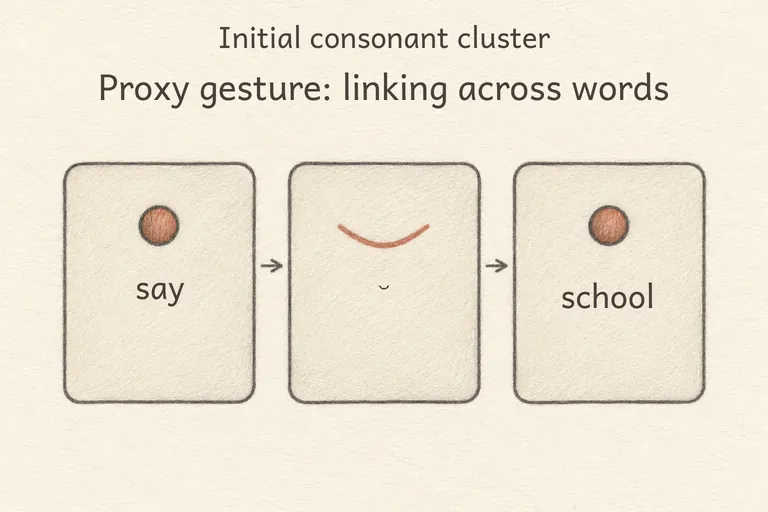
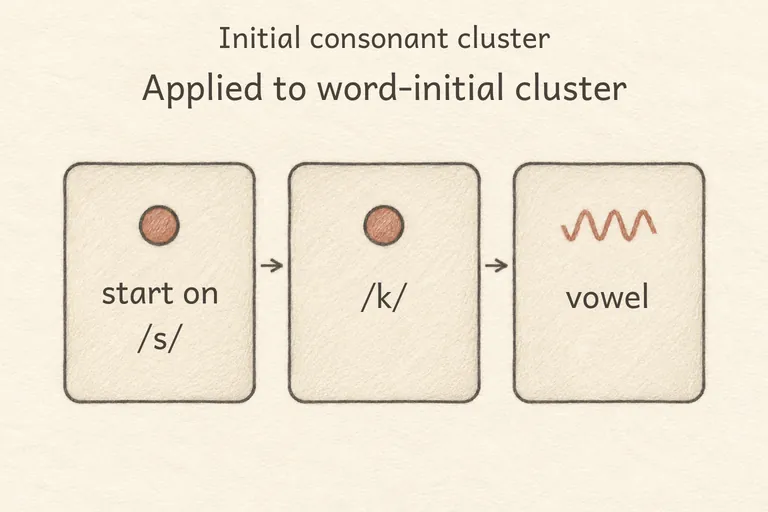
Why this works. Linking the word-initial 's' to the final vowel of the preceding word (e.g., saying 'is state' with the 's' gliding straight across the word boundary) borrows the motor routine learners already use for native-like consonant-to-vowel resyllabification, giving the s-cluster a familiar coda-like onset environment that naturally suppresses the epenthetic vowel without requiring a brand-new articulatory plan.
Sources (1)
- Wells, J.C. (1982). Accents of English.
Freeze Into 's': No Vowel Allowed
consensus- Say 'state' extremely slowly and pause right at the very beginning, before any sound starts.
- Check in the mirror that your jaw has not dropped open — your mouth should already be in the 's' shape.
- Slowly let air hiss through for the 's' sound, holding it for two full seconds without any vowel sneaking in before it.
- Move directly from the held 's' into the 't' sound, freezing again briefly at that transition.
- Release into the rest of the word 'state' at a slow, controlled pace.
- Repeat the whole frozen sequence three times, then gradually speed it up.
- Say 'state' at normal speed and confirm it still has no vowel before the 's'.
Success check: At each freeze point your mouth should already be in a consonant shape, never an open vowel shape, and the final normal-speed word should contain exactly one syllable.
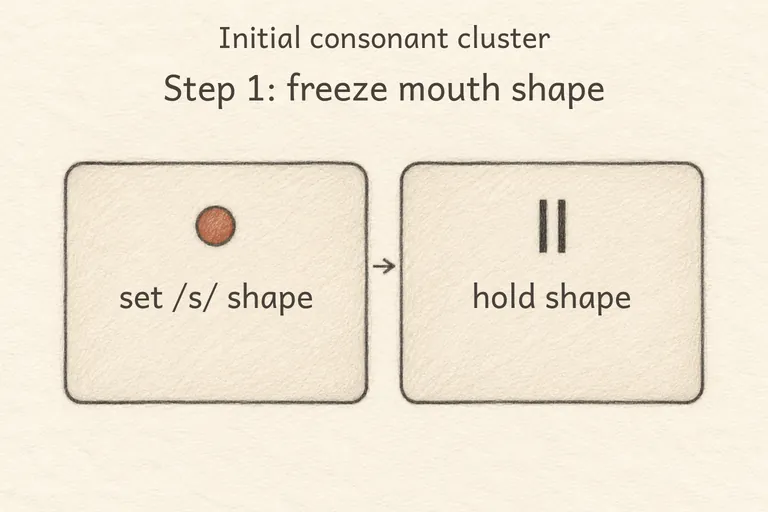
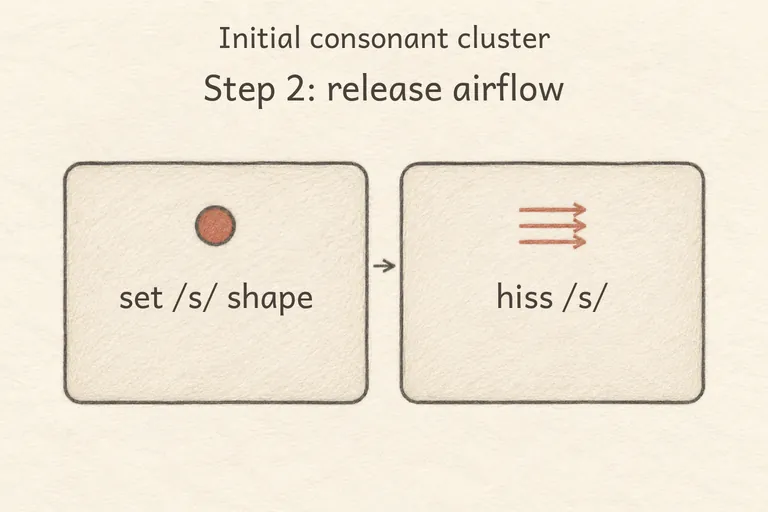

Why this works. Freezing the articulators in the s-cluster's pre-vocalic configuration before any airflow begins lets learners physically confirm that no vowel-opening gesture is present, breaking the automatic epenthesis habit step by step before reassembling the cluster at normal speed.
Sources (1)
- Wells, J.C. (1982). Accents of English.
Reader ratings and feedback are coming soon.
Sources (1)
- Wells, J.C. (1982). Accents of English.
Loads videos from YouTube via YouGlish; YouTube may set cookies.
state in YouGlish examples