/w/as in win
You likely pronounce this sound correctly on its own, but because Spanish 'v' is really pronounced with the lips like a 'b', you may also use this same rounded-lip w-sound for English words spelled with v, making 'vest…
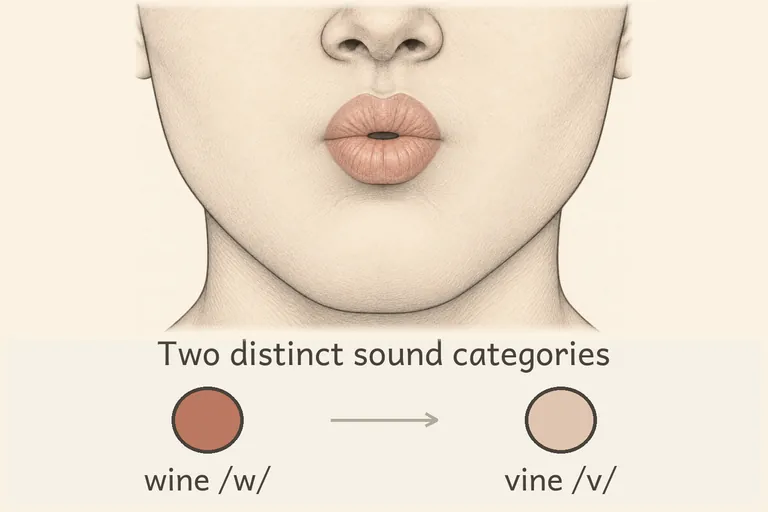
What you probably do
You likely pronounce this sound correctly on its own, but because Spanish 'v' is really pronounced with the lips like a 'b', you may also use this same rounded-lip w-sound for English words spelled with v, making 'vest' and 'west' sound the same.
How natives do it
Keep your correct rounded, forward-lip w for w-spelled words, but for v-spelled words, bring your lower lip up to touch your upper front teeth instead, creating a completely different, buzzing contact sound.
Why it matters
Because English treats w and v as fully separate sounds that change word meaning, collapsing them into one can create genuine confusion between common word pairs like 'wine' and 'vine' or 'west' and 'vest', not just an accent.
Hear the difference
Words this touches
Spanish speakers often substitute /w, b/.
How the mouth differs
Spanish already has a glide close to w (as in 'agua'), so the sound itself is easy, but because Spanish has no separate labiodental v — its 'v' spelling is pronounced with the lips, close to b — many learners map both English v and English w onto the same rounded-lip sound, erasing a distinction English keeps separate.
Listen for the pattern
Listeners commonly hear 'vest' and 'west', or 'vine' and 'wine', as identical, since the lower lip never touches the upper teeth the way English v requires, causing a genuine, not just accented, ambiguity between these word pairs.
Practise it
Train Your Ear: W vs V
sourced- Listen to these word pairs spoken by a native speaker: west/vest, wine/vine, wet/vet, worse/verse.
- For each pair, close your eyes and just guess which one you heard — don't look at the spelling yet.
- Notice that v has a light buzzing, humming quality (lip touching teeth), while w has a smooth, rounded, almost vowel-like quality with zero buzz.
- Listen again and briefly hum the v sound before each v-word to prime your ear for the buzz.
- Then listen specifically for its total absence before each w-word.
- Repeat the full list three times, checking your guesses against the written words only at the end.
Success check: You can tell 'west' from 'vest' by ear alone, specifically by noticing the presence or absence of a buzzing hum at the start.
Why this works. Perceptual confusion between w and v typically reflects mapping a new sound onto an existing L1 fricative category rather than an inability to hear the acoustic difference; discrimination practice that highlights the contrast directly targets this categorization problem before production training begins.
Sources (1)
- Distinguishing universal and language-dependent levels of speech perception: Evidence from Japanese listeners' perception of English “l” and “r” — Virginia A. Mann, 1986
- Japanese listeners successfully discriminate the acoustic properties of English /l/ and /r/ when presented with non-English contrasts, ruling out a universal hearing deficit.
- The primary source of error is language-dependent categorization, where listeners map English sounds onto their existing L1 phonological categories (e.g., classifying both as liquids).
- Performance improves significantly when the acoustic contrast between /l/ and /r/ is exaggerated or presented in contexts that highlight their distinctiveness.
Drill Sentence: Keep the Buzz Out of W
sourced- Read this sentence once silently: 'We will watch the wild white whales swim west while the wind blows.'
- Underline every w sound in the sentence — there are many.
- Say the sentence very slowly, rounding your lips firmly for every underlined w and double-checking your lip never touches your teeth.
- Record yourself saying it at a normal conversational pace.
- Play it back and listen specifically for any buzzing — if you hear it, that w slipped into a v.
- Repeat the sentence five times, gradually speeding up while keeping the lips rounded and buzz-free.
Success check: Your recording of the full sentence has smooth, rounded w's throughout, with no buzzing v-like sound anywhere.
Why this works. Drilling a w-dense sentence at connected-speech pace trains the learner to maintain the rounded, buzz-free glide under coarticulatory pressure from surrounding sounds, which isolated word practice doesn't test. Training gains tend to be larger when target sounds are practiced embedded in sentences rather than elicited in isolation.
Sources (1)
- Training the pronunciation of L2 vowels under different conditions: the use of non-lexical materials and masking noise. — Joan C Mora, Mireia Ortega, Ingrid Mora-Plaza et al., 2022
- Non-lexical training materials produced greater pronunciation improvements for L2 learners compared to lexical (word-based) materials.
- Masking noise during training hindered performance specifically for participants using non-lexical stimuli, but did not negatively affect those using words.
- Training-induced gains in vowel production were more pronounced when vowels appeared in sentences than when elicited in isolated words.
Exaggerate the Round, Then Dial It Back
sourced- Say 'west' but hold the rounded-lip position for a full 2 seconds before releasing into the vowel, like a cartoon fish face.
- Say 'wine' the same exaggerated way, holding the extreme lip-pucker before gliding in.
- Record these exaggerated versions and check in the mirror that your lips never touch your teeth.
- Now repeat both words holding the rounded shape for only half a second.
- Then repeat them at completely natural conversational speed, with just a quick flash of rounding.
- Compare your natural-speed recording to your exaggerated one — the rounding should still be there, just much faster.
Success check: At natural speed, your w still starts with a brief, clear lip-rounding and absolutely no buzzing, even though you can no longer see it held for a full two seconds.
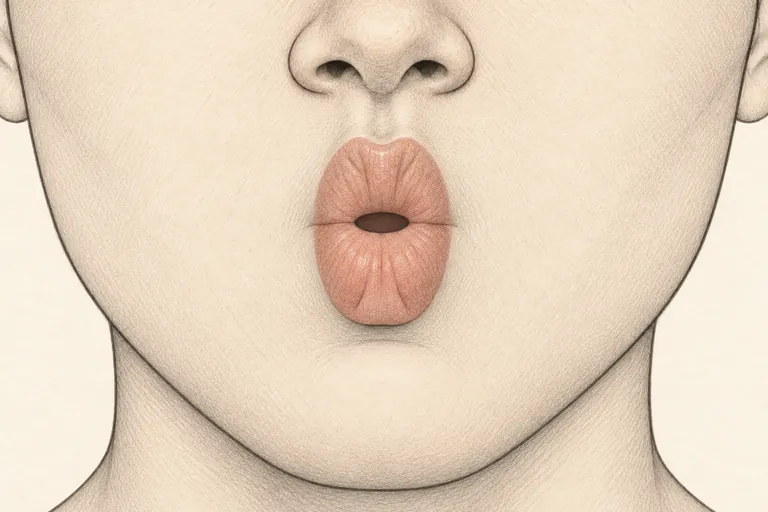
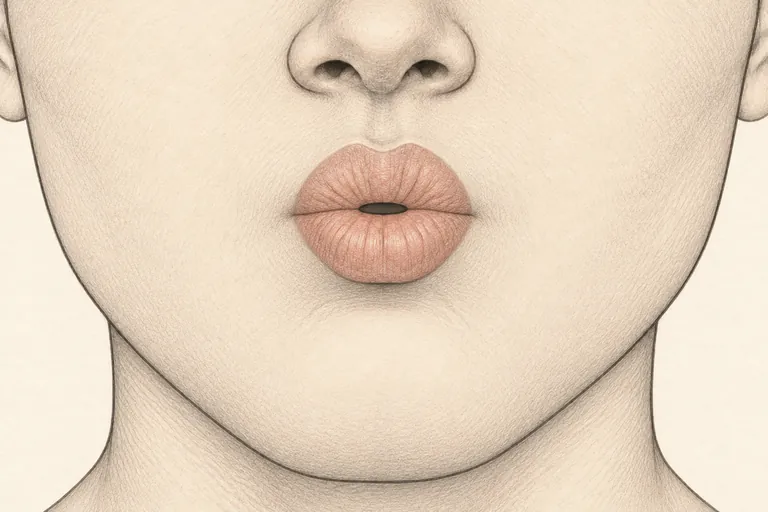
Why this works. Holding the lip-rounding gesture in an exaggerated, extended form before fading it toward natural speed strengthens the motor and perceptual category for w, since temporal exaggeration during training has been shown to induce more native-like categorical processing that persists once the exaggeration is removed.
Sources (1)
- Frontiers | The Role of Temporal Acoustic Exaggeration inHigh... — 2019
- The HVPT-E group showed superior improvement in natural word identification compared to the standard HVPT group.
- Temporal acoustic exaggeration promotes native-like categorical perception based on spectral cues in adult L2 learners.
- Training with temporal exaggeration induces measurable changes in pre-attentive neural processing (MMN responses).
Say It, Don't Buzz It: Producing W
sourced- Stand in front of a mirror and say 'vest' — watch your lower lip rise to touch your upper teeth.
- Now say 'west' and consciously keep your lower lip completely away from your teeth, pushing both lips forward into a tight round circle instead, like you're about to whistle.
- Hold that rounded-lip shape for a full second before releasing into the rest of the word: wwwww-est.
- Record yourself saying: west, wine, wet, worse, one after another.
- Play it back and listen for any leftover buzzing — that means your lip touched your teeth.
- If you hear buzzing, repeat the word, this time starting with your lips already rounded and away from your teeth before you even start voicing.
- Finish by alternating rapidly between a v-word and its w-pair: vest-west, vine-wine, vet-wet, verse-worse.
Success check: Your w-words have zero buzzing friction and a round, smooth glide instead, and a listener can clearly tell 'west' from 'vest' in your recording.
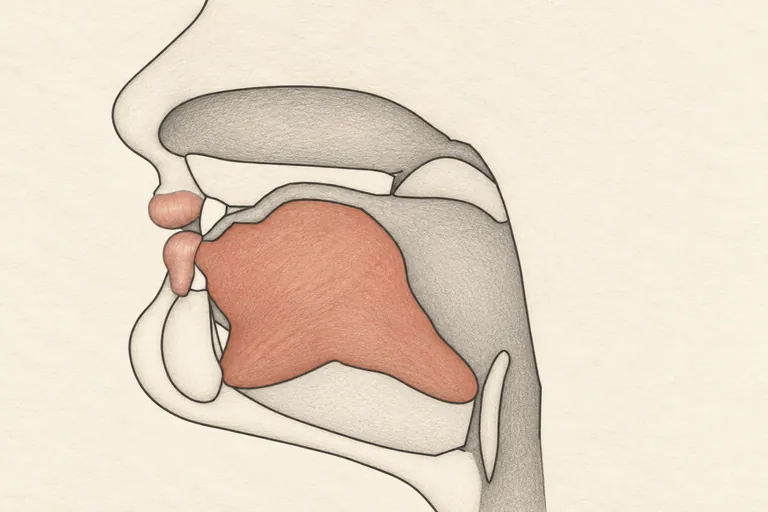
Why this works. Trains deliberate production of w with zero lip-to-teeth contact against the habitual v substitution. Tracking both goodness (how correct it sounds) and intelligibility (whether listeners understand it) gives a fuller picture of progress than accuracy alone, which matters here since a slightly imperfect w can still be far more intelligible than a buzzing v.
Sources (1)
- Using multiple measures to document change in English vowels produced by Japanese, Korean, and Spanish speakers: the case for goodness and intelligibility. — Amber D Franklin, Carol Stoel-Gammon, 2014
- Both goodness ratings and intelligibility scores effectively captured improvements in vowel accuracy following pronunciation training.
- The relationship between goodness and intelligibility varies by vowel; vowels like /æ/ and /ʌ/ depend more on goodness for listener identification than /i/ and /e/.
- Some vowels received better mean intelligibility scores but poorer mean goodness ratings after training, indicating that high intelligibility does not always require high perceived quality.
Borrow Your Rounded Vowel to Build W
generated- Say a word with a long, rounded vowel like Hungarian 'húz' or 'tűz', and freeze your lips in that tightly rounded, protruded shape.
- Notice this is the exact same lip shape English w needs — hold it and check your lower lip is nowhere near your teeth.
- Now, instead of holding the rounded shape as a vowel, make it quick and glide immediately into the next vowel: 'ú' + e = 'we'.
- Practice this glide version alone several times: oo-we, oo-we, oo-we, shortening the 'oo' part each time.
- Move into real words: we, west, wine, wet, always starting from that borrowed rounded-vowel lip shape.
- Confirm in the mirror that your starting lip shape for each w-word matches your rounded-vowel shape exactly.
Success check: Each w-word starts with the same rounded lips you already use for a rounded vowel, just turned into a fast glide instead of a held vowel — no lip-to-teeth contact at any point.
Why this works. English w shares its lip-rounding and protrusion gesture almost exactly with high back rounded vowels like Hungarian 'ú' or 'ü', sounds many learners already produce fluently. Borrowing that pre-existing rounded-lip motor program and simply turning it into a brief glide, rather than building lip rounding from zero, reduces interference from the habitual labiodental substitution.
Slow-Motion Steps: Building W From Scratch
consensus- Step 1 – Lips only: push both lips forward into a tight, round shape, like you're about to whistle. Make sure your lower lip does NOT touch your upper teeth. Hold for 2 seconds.
- Step 2 – Add the tongue: keeping your lips rounded, lift the back of your tongue up toward the roof of your mouth, without touching it. Hold both at once.
- Step 3 – Add voice: turn on your voice and glide smoothly out of that rounded, raised position into an 'oo' sound: wwwoooo.
- Now shorten the glide until it's quick: practice just 'w' + 'e' = 'we', very slowly at first.
- Build up to full words: we, way, west, wet, one step at a time, keeping lips rounded and away from the teeth the whole time.
- Check in the mirror after each word that your lower lip never rose to meet your teeth.
Success check: You can feel both lip-rounding and tongue-back-raising happening together, with absolutely no lip-to-teeth contact, right before each w-word.

Why this works. Isolating the two simultaneous articulatory components of w — lip rounding/protrusion and tongue-back raising toward the velum — into separate deliberate steps lets learners build each piece before combining them, bypassing the habitual labiodental substitute gesture entirely.
Sources (1)
- Kenesei, I., Vago, R.M., & Fenyvesi, A. (1998). Hungarian: Descriptive Grammar.
Reader ratings and feedback are coming soon.
Sources (2)
- Wells, J.C. (1982). Accents of English.
- Hualde, J.I. (2005). The Sounds of Spanish. Cambridge University Press.
Loads videos from YouTube via YouGlish; YouTube may set cookies.
west in YouGlish examples