/ɛ/as in bed
You likely pronounce the vowel in 'bed' or 'said' with a tongue position that's a bit too high and front, closer to the glide you use in Mandarin ei, since Mandarin has no separate steady vowel at this exact height and…
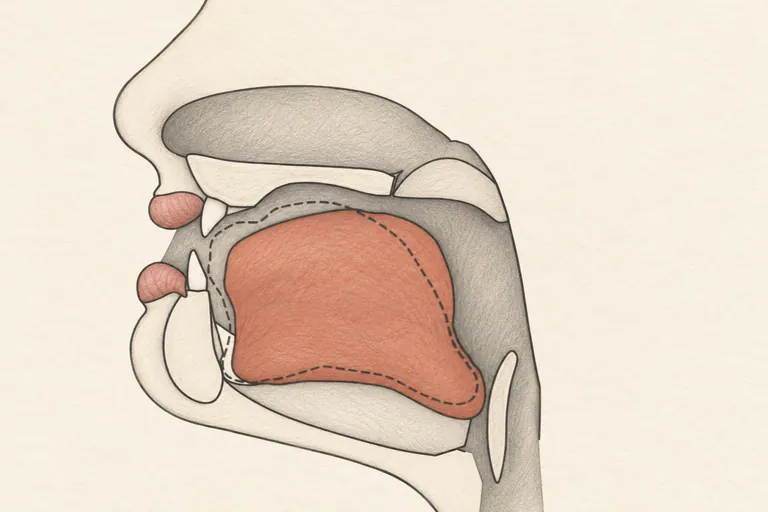
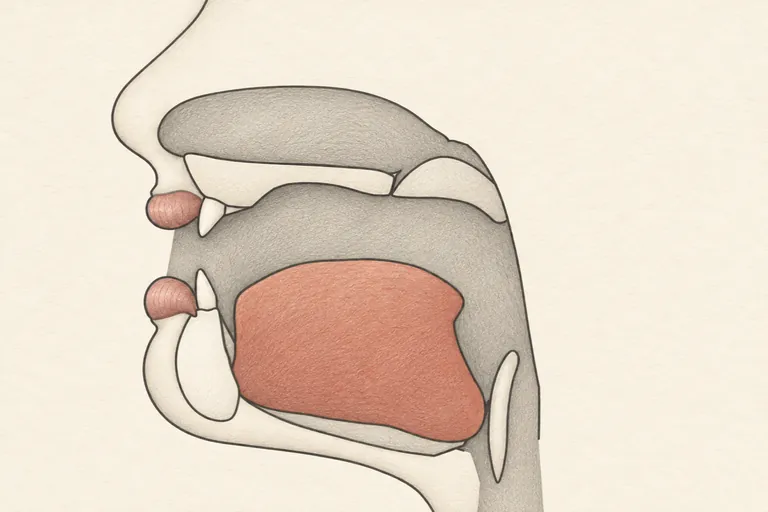
What you probably do
You likely pronounce the vowel in 'bed' or 'said' with a tongue position that's a bit too high and front, closer to the glide you use in Mandarin ei, since Mandarin has no separate steady vowel at this exact height and openness.
How natives do it
Americans open the jaw a bit more than for the 'ay' vowel and keep the tongue flat and steady in a mid-low front position for the whole sound, without letting it rise or glide anywhere. This is the short 'eh' sound in 'bed' and 'said'.
Why it matters
Raising this vowel toward e makes common word pairs like 'bet' and 'bait', or 'wet' and 'wait', sound alike to native listeners, which can genuinely confuse meaning in everyday conversation. Practicing a lower, steadier jaw position for this vowel, without letting it glide, is a high-value fix.
Hear the difference
Words this touches
Mandarin Chinese speakers often substitute /e/.
How the mouth differs
Mandarin has no standalone mid-low front monophthong matching English ɛ; its closest front-vowel resources are the higher, gliding ei diphthong and the vowel found in the diphthong ie. Learners typically raise and sometimes glide this vowel toward the e/ei quality, rather than holding a steady, lower, jaw-open position.
Listen for the pattern
Raising ɛ toward e causes pairs like 'bet' and 'bait' to merge for the listener, which is a frequent and noticeable source of word-level misunderstanding for Mandarin-speaking learners.
Practise it
Exaggerate, then Dial Back: Finding True ɛ
sourced- Say the word 'bet' with your normal, higher tongue position and notice how it feels.
- Now open your jaw much wider than feels natural and drop your tongue very low, saying 'bet' again in an exaggerated, almost silly way.
- Repeat the exaggerated version three times, feeling the big difference from your habitual position.
- Gradually reduce the exaggeration by about half, saying 'bet' again with a smaller — but still noticeable — jaw drop.
- Reduce one more time until the jaw drop feels natural but still clearly lower than your first attempt.
- Compare 'bet' and 'bait' back to back, checking that 'bet' keeps the lower jaw position.
- Record yourself saying both words and listen for a clear height difference.
Success check: You should feel your jaw and tongue settle in a clearly lower position for 'bet' than for 'bait', and the two words should sound distinctly different, not identical.
Why this works. Overshooting the jaw-lowering and tongue-lowering gesture for ɛ beyond the normal target, then gradually dialing back to the correct degree, creates a clearer acoustic contrast (higher F1) against a habitual mid-front e substitute; research on acoustic exaggeration in phonetic training shows this strengthens categorical perception and production before the exaggeration is faded.
Sources (2)
- Distinguishing universal and language-dependent levels of speech perception: Evidence from Japanese listeners' perception of English “l” and “r” — Virginia A. Mann, 1986
- Japanese listeners successfully discriminate the acoustic properties of English /l/ and /r/ when presented with non-English contrasts, ruling out a universal hearing deficit.
- The primary source of error is language-dependent categorization, where listeners map English sounds onto their existing L1 phonological categories (e.g., classifying both as liquids).
- Performance improves significantly when the acoustic contrast between /l/ and /r/ is exaggerated or presented in contexts that highlight their distinctiveness.
- The Role of Temporal Acoustic Exaggeration in High Variability Phonetic Training: A Behavioral and ERP Study — Bing Cheng, Xiaojuan Zhang, Siying Fan et al., 2019
- The HVPT-E group showed greater improvement in natural word identification performance compared to the standard HVPT group.
- Training with temporal acoustic exaggeration induced native-like categorical perception based on spectral cues.
- MMN responses demonstrated training-induced changes at pre-attentive neural levels, suggesting enhanced brain plasticity.
Hear the Glide vs. the Flat Vowel
sourced- Play the recording of 'bait' and 'bet' back to back, several times.
- Close your eyes and just listen for whether the vowel glides upward or stays flat.
- Write down 'A' or 'B' as you hear each word in a shuffled sequence of the pair.
- Check your answers against the answer key.
- Repeat the same listening task with 'wait/wet', 'late/let', and 'mate/met'.
- Note any pair where you consistently guess wrong, and replay it five extra times.
Success check: You can correctly identify at least 8 out of 10 shuffled words across the four minimal pairs without seeing the spelling.
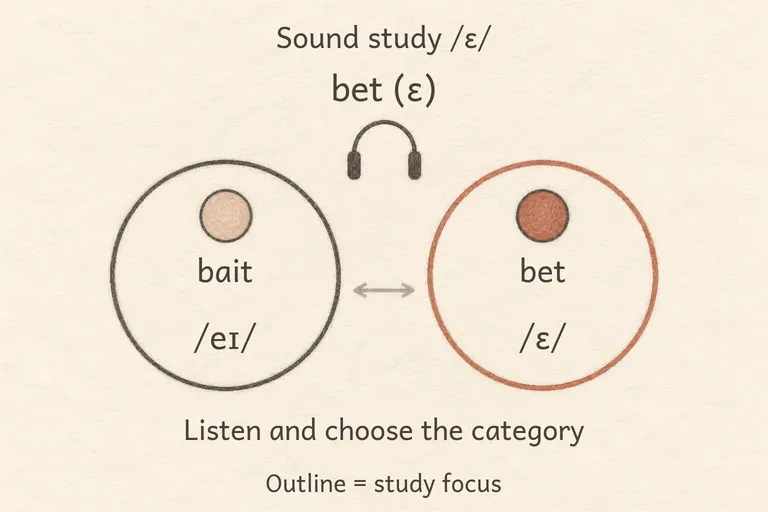
Why this works. Repeated AX/ABX listening on pairs that differ only in vowel height and glide presence trains perceptual categorization along the one acoustic dimension that gets collapsed, strengthening the learner's internal category boundary before production practice begins.
Sources (1)
- Using multiple measures to document change in English vowels produced by Japanese, Korean, and Spanish speakers: the case for goodness and intelligibility. — Amber D Franklin, Carol Stoel-Gammon, 2014
- Both goodness ratings and intelligibility scores effectively captured improvements in vowel accuracy following pronunciation training.
- The relationship between goodness and intelligibility varies by vowel; vowels like /æ/ and /ʌ/ depend more on goodness for listener identification than /i/ and /e/.
- Some vowels received better mean intelligibility scores but poorer mean goodness ratings after training, indicating that high intelligibility does not always require high perceived quality.
Drill ɛ in Full Sentences
sourced- Read silently: 'I said the red-headed man gets many letters every week,' noting the underlined ɛ words.
- Say the sentence slowly, dropping your jaw clearly on 'said', 'red', 'gets', 'many', and 'letters'.
- Speed up to a natural conversational pace while keeping the same jaw opening on those words.
- Record yourself reading the sentence at natural speed.
- Listen back and mark any ɛ word that sounds too close to the eɪ vowel in 'day'.
- Reread the sentence, exaggerating the jaw drop only on the marked words.
Success check: At natural speed, every targeted word ('said', 'red', 'gets', 'many', 'letters') has a clearly open, flat vowel with no upward glide.
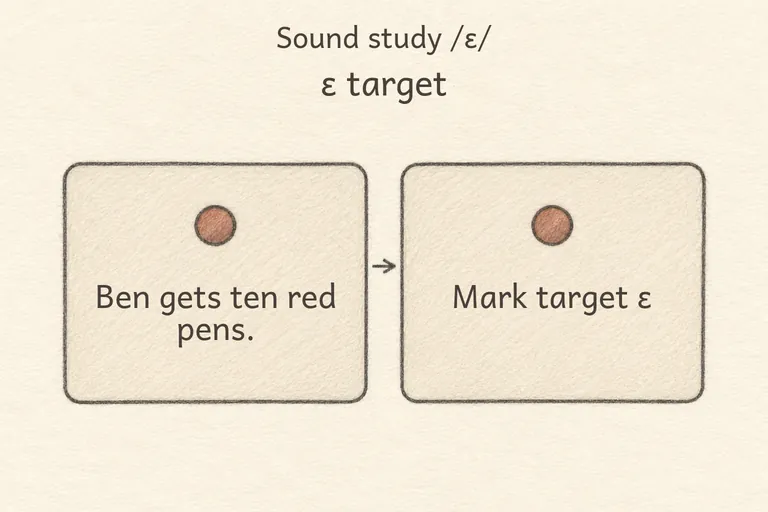
Why this works. Embedding the target vowel in full carrier sentences rather than isolated words gives the learner practice maintaining the lower, glide-free articulation under natural coarticulatory and rhythmic pressure, which training research shows produces more pronounced, durable gains than isolated-word drills alone.
Sources (1)
- Training the pronunciation of L2 vowels under different conditions: the use of non-lexical materials and masking noise. — Joan C Mora, Mireia Ortega, Ingrid Mora-Plaza et al., 2022
- Non-lexical training materials produced greater pronunciation improvements for L2 learners compared to lexical (word-based) materials.
- Masking noise during training hindered performance specifically for participants using non-lexical stimuli, but did not negatively affect those using words.
- Training-induced gains in vowel production were more pronounced when vowels appeared in sentences than when elicited in isolated words.
Produce the Pair Contrast
sourced- Say 'bait' first, feeling your tongue glide slightly upward.
- Immediately say 'bet', dropping your jaw more and keeping the tongue flat with no glide.
- Repeat the 'bait–bet' pair five times, exaggerating the jaw drop on 'bet'.
- Record yourself saying all four pairs: bait/bet, wait/wet, late/let, mate/met.
- Play back the recording and check that each ɛ word sounds clearly lower and flatter than its eɪ partner.
- Redo any pair that sounds too similar, dropping your jaw even further on the ɛ word.
Success check: A listener (or you, on playback) can clearly tell which word in each pair is which, based on jaw height and the presence or absence of a glide.
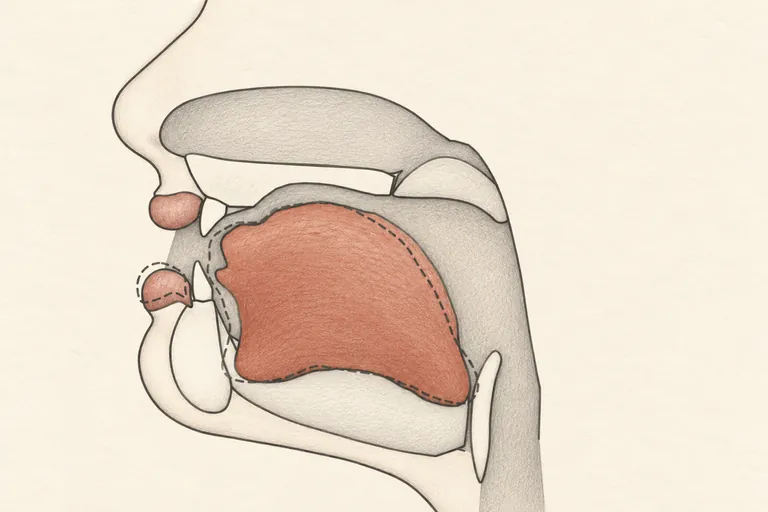
Why this works. Producing the two members of each minimal pair back-to-back forces the learner to actively control tongue height and glide presence as the sole distinguishing gesture, converting the perceptual contrast established in listening practice into a reliable, repeatable articulatory routine.
Sources (1)
- Using multiple measures to document change in English vowels produced by Japanese, Korean, and Spanish speakers: the case for goodness and intelligibility. — Amber D Franklin, Carol Stoel-Gammon, 2014
- Both goodness ratings and intelligibility scores effectively captured improvements in vowel accuracy following pronunciation training.
- The relationship between goodness and intelligibility varies by vowel; vowels like /æ/ and /ʌ/ depend more on goodness for listener identification than /i/ and /e/.
- Some vowels received better mean intelligibility scores but poorer mean goodness ratings after training, indicating that high intelligibility does not always require high perceived quality.
Use 'Cat' as a Springboard to 'Bed'
consensus- Say 'cat' and notice how wide open your jaw drops for that vowel.
- Hold that same open jaw position without moving it.
- From that position, raise only your tongue body slightly higher, without closing the jaw.
- Add voice and say 'bed' using this adjusted tongue height with the same open jaw.
- Alternate saying 'cat' then 'bed' five times, feeling the small tongue-height change while the jaw stays equally open.
- Record both words and compare your 'bed' vowel to a native model's ɛ.
Success check: Your jaw stays about as open for 'bed' as it is for 'cat', but the vowel sound is clearly higher and more ɛ-like than æ.
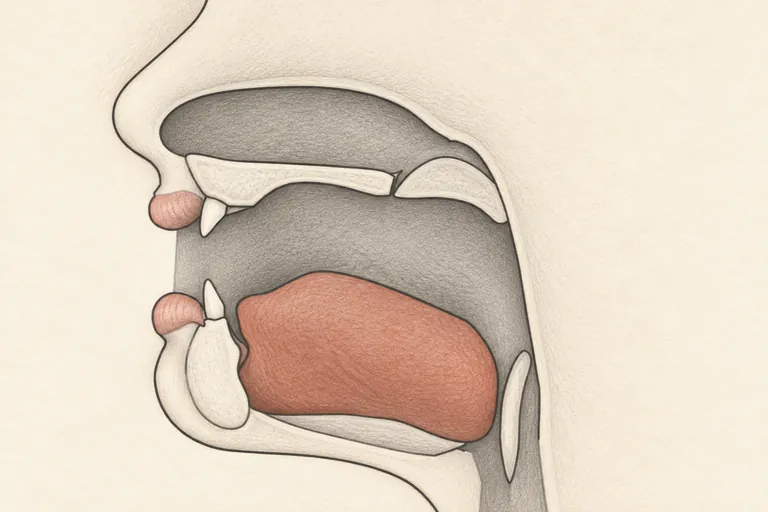
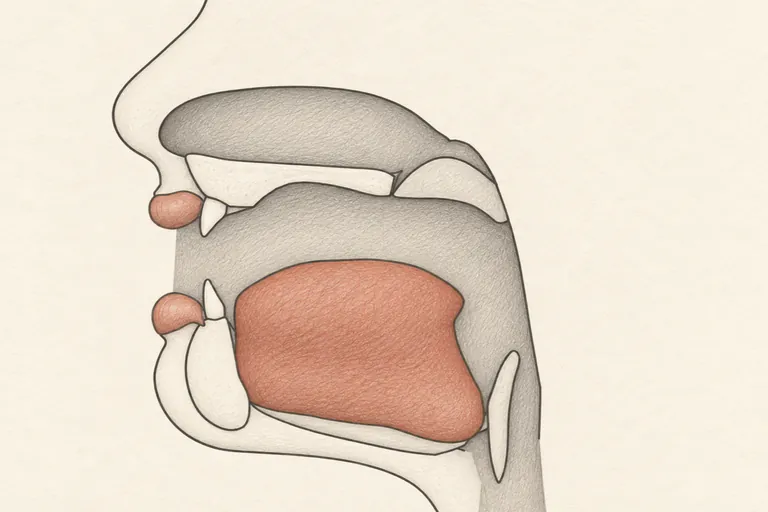
Why this works. English ɛ shares its jaw-lowering gesture with the vowel æ (as in 'cat'), which Spanish-background learners typically already produce with an adequately open jaw; by starting from the æ jaw position and raising the tongue body slightly while keeping the same open jaw, the learner recruits the same jaw-depressor muscle activity already mastered for æ as a proxy motor target for ɛ.
Sources (1)
- Hualde, J.I. (2005). The Sounds of Spanish. Cambridge University Press.
Build the Vowel in Slow Motion
sourced- Look in a mirror and open your jaw as if starting to say 'bed', but freeze in that open position.
- Check that your jaw is clearly more open than when you say 'bait'.
- Hold that open position steady for two full seconds without moving your tongue.
- Now add voice and say a flat, held vowel for two seconds, keeping the jaw position frozen.
- Shorten the held vowel gradually over several repetitions until it's a normal-length syllable.
- Say the full word 'bed' at normal speed, keeping the same jaw opening you practiced.
- Record the final normal-speed version and compare it to a native model.
Success check: In the mirror, your jaw is visibly more open on 'bed' than on 'bait', and the vowel sound stays flat with no upward glide even at normal speed.
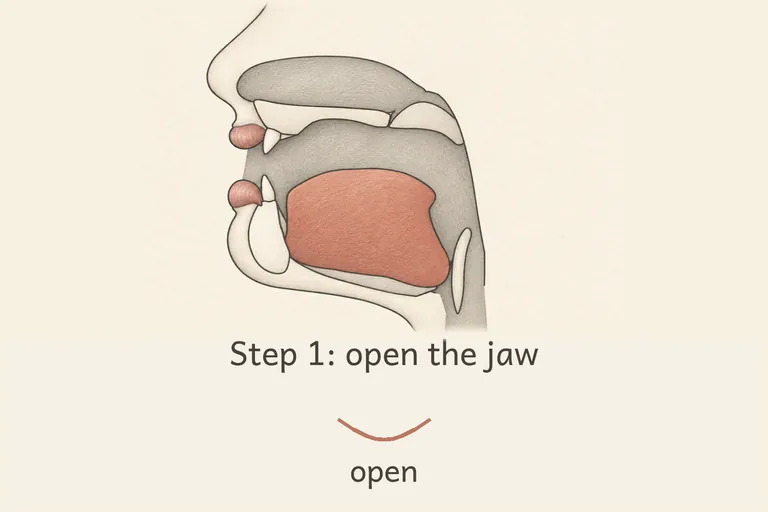
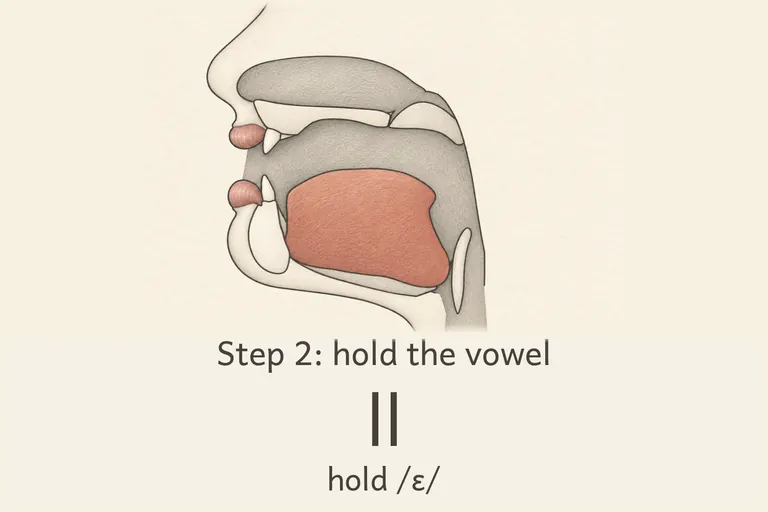
Why this works. Slowing the vowel articulation into discrete steps — mouth-open position, tongue height check, steady hold — lets the learner consciously verify jaw opening and the absence of an off-glide before reintegrating the sound at normal speed, addressing the core articulatory error of insufficient lowering.
Sources (1)
- Training the pronunciation of L2 vowels under different conditions: the use of non-lexical materials and masking noise. — Joan C Mora, Mireia Ortega, Ingrid Mora-Plaza et al., 2022
- Non-lexical training materials produced greater pronunciation improvements for L2 learners compared to lexical (word-based) materials.
- Masking noise during training hindered performance specifically for participants using non-lexical stimuli, but did not negatively affect those using words.
- Training-induced gains in vowel production were more pronounced when vowels appeared in sentences than when elicited in isolated words.
Reader ratings and feedback are coming soon.
Sources (1)
- Duanmu, S. (2007). The Phonology of Standard Chinese. Oxford University Press.
Loads videos from YouTube via YouGlish; YouTube may set cookies.
bet in YouGlish examples