/d/as in dog
You likely curl your tongue tip back for this sound, as in Hindi's retroflex ड, or press it against your teeth the way you would for the dental sound you also use to replace English 'th', instead of resting it on the…
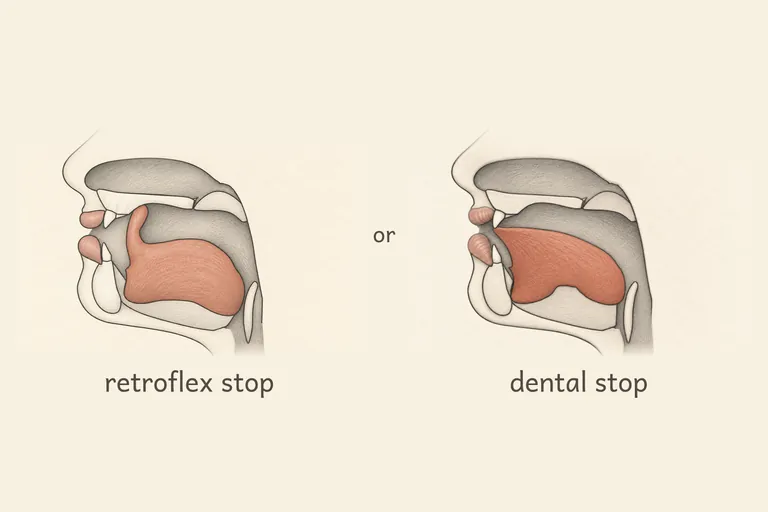
What you probably do
You likely curl your tongue tip back for this sound, as in Hindi's retroflex ड, or press it against your teeth the way you would for the dental sound you also use to replace English 'th', instead of resting it on the ridge just behind your upper teeth.
How natives do it
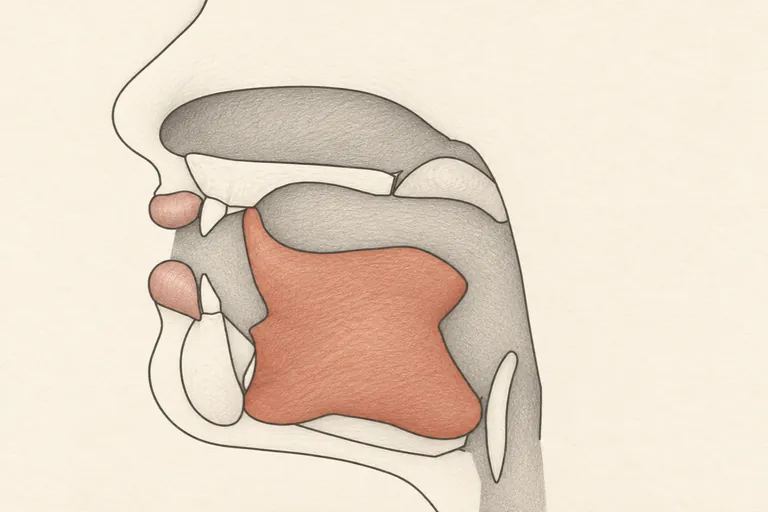
Americans place the tongue tip flat against the alveolar ridge, keep the voicing on throughout, and release softly with no puff of air — and between two vowels, as in 'ladder', this often reduces further to the same quick tap used for intervocalic t.
Why it matters
A retroflex or dental d is one of the clearest accent markers for Hindi speakers, and the dental version in particular can make 'day' and 'they' sound confusingly similar; moving the tongue forward to the alveolar ridge sharpens the distinction and softens the accent.
Hear the difference
Words this touches
Hindi (Modern Standard Hindi) speakers often substitute /ɖ, d̪/.
How the mouth differs
English d is alveolar. Hindi lacks a true alveolar stop and instead contrasts dental d̪ with retroflex ɖ; Hindi speakers commonly substitute the retroflex ɖ for English d, curling the tongue tip back, or use the dental d̪, which also doubles as their usual substitute for English ð.
Listen for the pattern
Like its voiceless counterpart t, a retroflex d is a strongly recognizable marker of South Asian-accented English; the dental substitute can also blur the distinction between d-words and th-words for some listeners.
Reader ratings and feedback are coming soon.
Sources (2)
- The effects of native language on Indian English sounds and timing patterns. — Hema Sirsa, Melissa A Redford, 2013
- Acoustic analysis of vowels, consonants, and timing patterns successfully differentiated between Hindi and Telugu native speech but failed to distinguish IE produced by speakers of these different backgrounds in most cases.
- Only three specific acoustic measures were able to differentiate Indian English produced by Hindi speakers versus Telugu speakers.
- Experienced listeners could accurately identify the speaker's native language background in IE, while naïve listeners could not, despite being able to distinguish between the native languages themselves.
- How to Improve English Pronunciation from Hindi | EnglishIntoHindi — 2026
- Hindi lacks specific English consonant sounds like /θ/ (th), /ð/, /ʃ/ (sh), /dʒ/, and /w/, requiring targeted articulation practice.
- English word stress patterns differ significantly from Hindi, with nouns typically stressing the first syllable while verbs stress the second.
- Intonation plays a critical role in conveying meaning and politeness, with rising tones used for questions and falling tones for statements.
Loads videos from YouTube via YouGlish; YouTube may set cookies.
day in YouGlish examples