/k/as in cat
You already have both plain and aspirated k in Hindi, but since that contrast marks different words rather than stress, you may default to the plain, unaspirated k at the start of English words, so 'cat' or 'key' can…
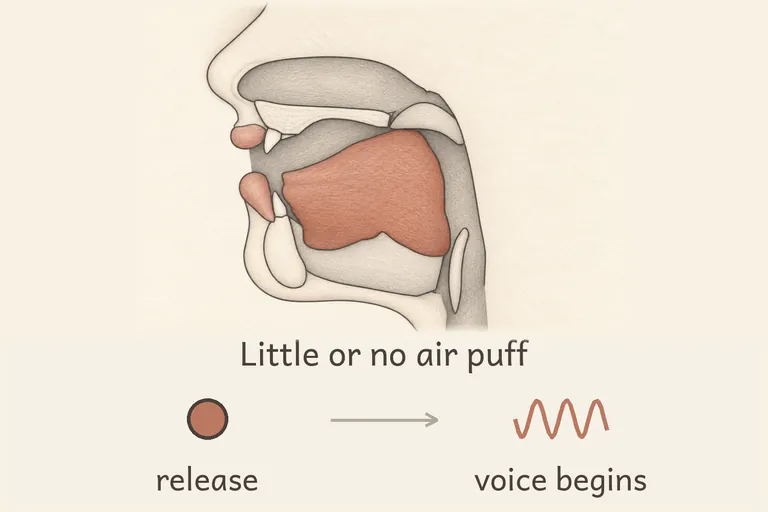
What you probably do
You already have both plain and aspirated k in Hindi, but since that contrast marks different words rather than stress, you may default to the plain, unaspirated k at the start of English words, so 'cat' or 'key' can sound a bit closer to 'gat' or 'ghee' to American ears.
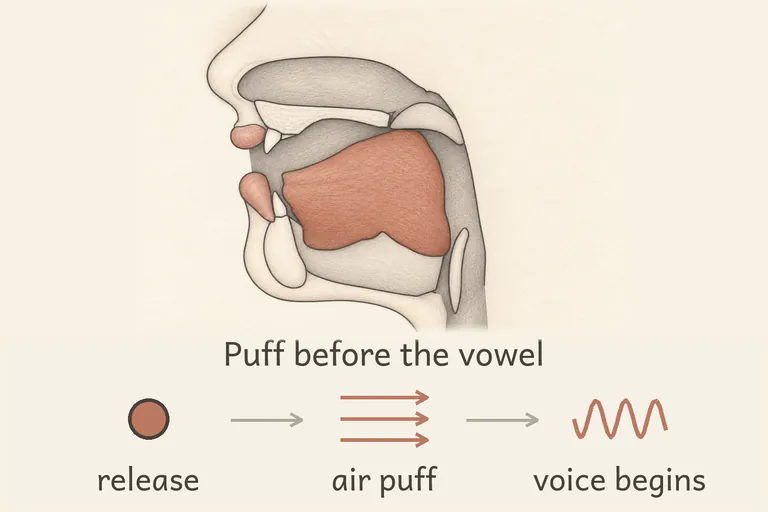
How natives do it
Americans aspirate k strongly at the start of stressed syllables, releasing a clear puff of air right after the tongue leaves the soft palate — test it with a tissue near your mouth on words like 'cat', 'key', or 'cup'.
Why it matters
Because English relies on aspiration, not voicing alone, to separate k from g at the start of words, adding a strong puff of air to stressed, word-initial k helps keep pairs like 'coat' and 'goat' clearly distinct for your listeners.
Hear the difference
Words this touches
Hindi (Modern Standard Hindi) speakers often substitute /k/.
How the mouth differs
Hindi contrasts unaspirated k and aspirated kʰ as separate phonemes used to distinguish meaning, not conditioned by stress. Hindi speakers may therefore under-aspirate English k at the start of stressed syllables, producing a plainer release than the strongly aspirated GA norm.
Listen for the pattern
An under-aspirated k can sound ambiguous with g to American listeners, since English g is also largely unaspirated, occasionally creating brief confusion in isolated words.
Reader ratings and feedback are coming soon.
Sources (1)
- Wells, J.C. (1982). Accents of English.
Loads videos from YouTube via YouGlish; YouTube may set cookies.
coat in YouGlish examples