/p/as in pen
You already have both plain and aspirated p sounds in Hindi, but because aspiration there signals a different meaning rather than stress, you may default to the plain, unaspirated p at the start of English words, so…
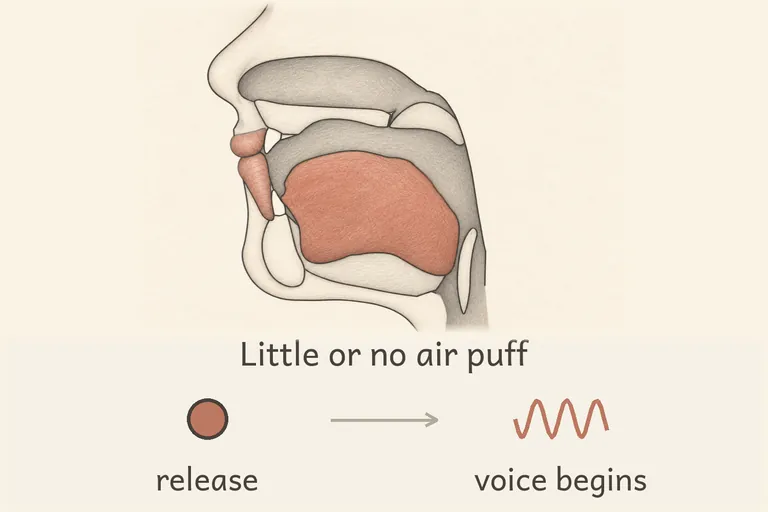
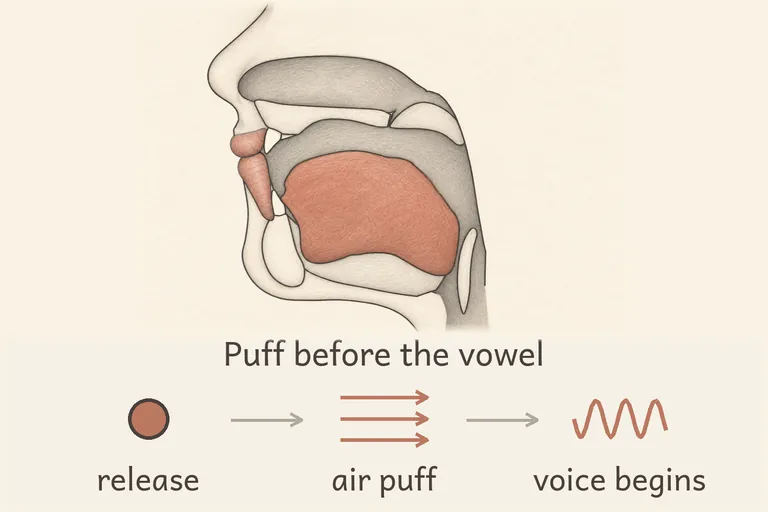
What you probably do
You already have both plain and aspirated p sounds in Hindi, but because aspiration there signals a different meaning rather than stress, you may default to the plain, unaspirated p at the start of English words, so 'pen' can sound a bit closer to 'ben' to American ears.
How natives do it
Americans aspirate p strongly whenever it starts a stressed syllable, releasing a clear puff of air right after the lips open — hold a tissue near your mouth and it should flutter noticeably on words like 'pen', 'pie', or 'upper'.
Why it matters
Since English doesn't use aspiration to distinguish separate words the way Hindi does, listeners rely on that puff of air to tell p apart from b at the start of words; adding strong aspiration to stressed, word-initial p keeps pairs like 'pin' and 'bin' clearly distinct.
Hear the difference
Words this touches
Hindi (Modern Standard Hindi) speakers often substitute /p/.
How the mouth differs
Hindi has both unaspirated p and aspirated pʰ as separate phonemes, but aspiration is used contrastively to distinguish meaning rather than conditioned by stress and syllable position as in English. Hindi speakers may therefore under-aspirate English p at the start of stressed syllables, producing something closer to Hindi's plain, unaspirated p.
Listen for the pattern
Because English b is also voiceless and largely unaspirated at the start of a word, an under-aspirated p can sound ambiguous between p and b to American listeners, occasionally causing brief confusion in words heard out of context.
Reader ratings and feedback are coming soon.
Sources (1)
- Wells, J.C. (1982). Accents of English.
Loads videos from YouTube via YouGlish; YouTube may set cookies.
pin in YouGlish examples