Final consonant release
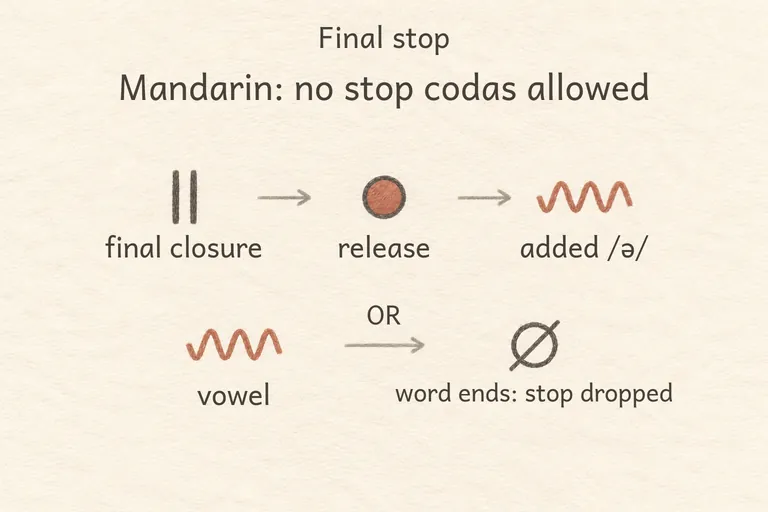
You may drop the final consonant in words like 'seat' or 'big,' making them sound like 'see' or 'bih,' or add a small extra vowel after it, turning a one-syllable word into something that sounds two-syllable, because…
What you probably do
You may drop the final consonant in words like 'seat' or 'big,' making them sound like 'see' or 'bih,' or add a small extra vowel after it, turning a one-syllable word into something that sounds two-syllable, because Mandarin syllables can't end in stop consonants.
How natives do it
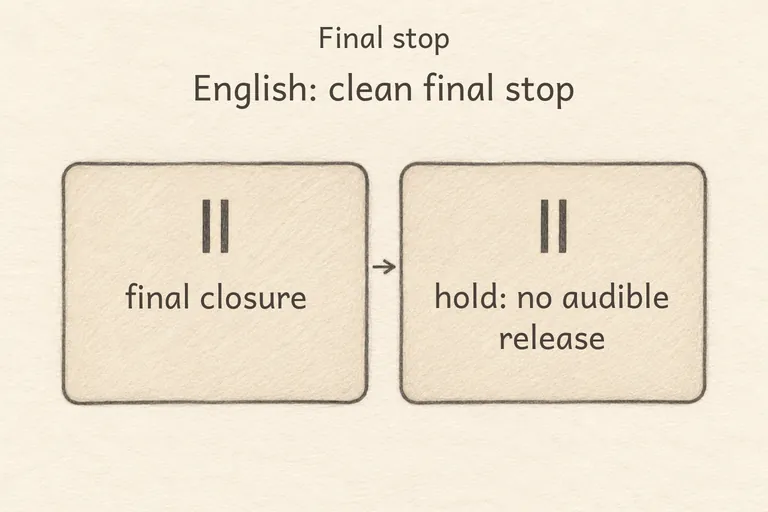
Americans end these words crisply on the final consonant itself, sometimes just holding the closure without a big release, but never adding an extra vowel sound afterward.
Why it matters
Dropped or vowel-added final consonants can make 'seat' sound like 'see' or 'light' sound like 'lie-ta,' creating real confusion about which word you mean, especially in fast conversation.
How the mouth differs
Mandarin syllables can only end in a vowel, n, or ng, never a stop consonant, so Mandarin speakers often add a small epenthetic vowel after English final stops or drop them altogether; English freely allows unreleased or glottalized final stops and complex final clusters without any extra vowel.
Listen for the pattern
Adding an extra vowel after a final consonant, or dropping it, turns single-syllable English words into something that sounds two-syllable or incomplete, which is one of the most noticeable markers of a Chinese accent.
Try these sentences
- Please take a seat.'seat' ends crisply on /t/, no added vowel
- That's a big decision.'big' ends on /g/, not 'biga'
Reader ratings and feedback are coming soon.
Sources (2)
- Common Accent Features of Mandarin Chinese Speakers in English — 2026
- Mandarin speakers frequently soften or drop final consonants (e.g., 'seat' becoming 'see') because Mandarin syllables rarely end in stops.
- An extra schwa vowel (/ə/) often appears at the end of English words, creating an unnatural two-syllable rhythm where English requires a single stressed syllable.
- Consonant clusters common in English (e.g., 'texts', 'school') are simplified or omitted by Mandarin speakers due to the language's avoidance of stacked consonants.
- Pronunciation Challenges Chinese Speakers Face in English — 2020
- Chinese speakers tend to break English consonant clusters by inserting a vowel or dropping one or more consonants because Chinese lacks final clusters and limits initial clusters to two consonants (one being Y/W).
- The dark L /ɫ/ does not exist in Mandarin, leading speakers to replace it with a schwa [ə] or unrounded u sound, often resulting in words like 'people' sounding like 'pipo'.
- Speakers frequently nasalize vowels at the end of syllables instead of producing the alveolar /n/, causing confusion between /n/ and /ŋ/ (e.g., 'sin' vs. 'sing').