Flap t
You probably pronounce the /t/ in words like 'butter,' 'water,' and 'city' as a clear, fully released stop, since Mandarin uses crisp articulation to keep aspirated and unaspirated consonants distinct.
What you probably do
You probably pronounce the /t/ in words like 'butter,' 'water,' and 'city' as a clear, fully released stop, since Mandarin uses crisp articulation to keep aspirated and unaspirated consonants distinct.
How natives do it
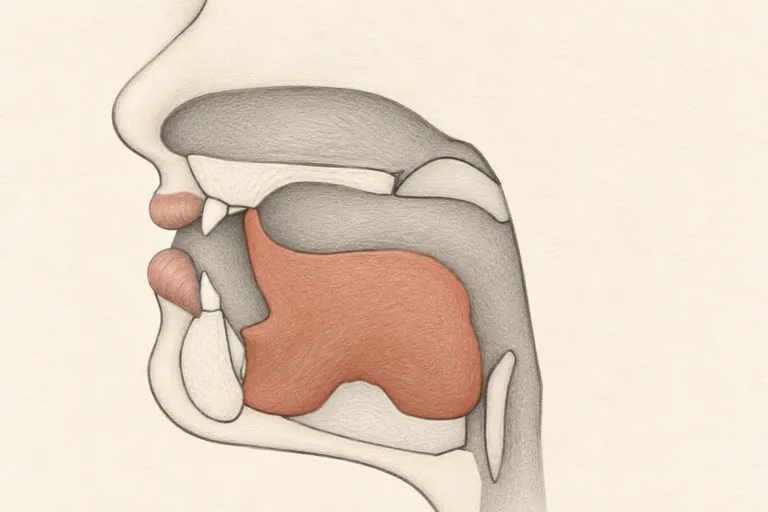
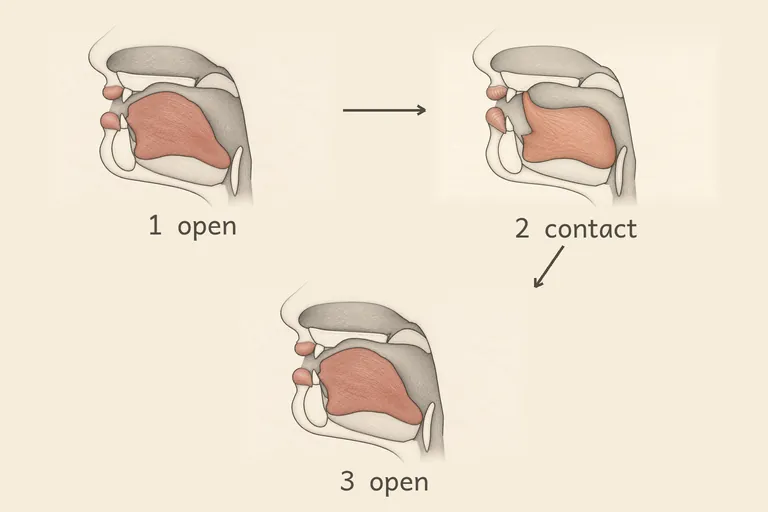
Americans tap the tongue tip very quickly and lightly against the ridge behind the teeth in this position, producing a sound closer to a fast, soft 'd' than a crisp 't'.
Why it matters
A fully pronounced /t/ here isn't wrong, but it sounds noticeably formal and can make your speech feel stiff or overly deliberate compared to the fast, relaxed flow native speakers expect in casual conversation.
How the mouth differs
General American routinely replaces intervocalic /t/ and /d/ with a fast alveolar tap in words like 'butter' and 'ladder'; Mandarin's /t/ is distinguished from /tʰ/ by aspiration, not by tapping, so Mandarin speakers tend to produce a fully released, clearly articulated stop in that position instead of the quick, lightly voiced tap.
Listen for the pattern
Fully pronounced /t/ in flap contexts sounds overly crisp, careful, or formal to American ears, subtly marking non-native speech even when every segment is 'correct.'
Try these sentences
- Can you pass the butter?'butter' flapped: [ˈbʌɾɚ]
- I'm going to the city.'city' flapped: [ˈsɪɾi]
Practise it
Overshoot the Tap, Then Lighten
sourced- Say 'butter' with the middle consonant sounding almost exactly like 'budder'.
- Repeat this exaggerated version three times, feeling the quick, loose tongue tap.
- Now say 'butter' again, lightening the tap slightly so it's not quite as 'd'-like.
- Say it one more time at a natural, comfortable speed.
- Repeat the whole sequence with 'water' and 'city'.
- Record your final natural versions and compare them to a native model.
Success check: Your natural version sounds like a quick, light tap — not a crisp held t, and not quite as voiced as your exaggerated 'd'-like practice version.
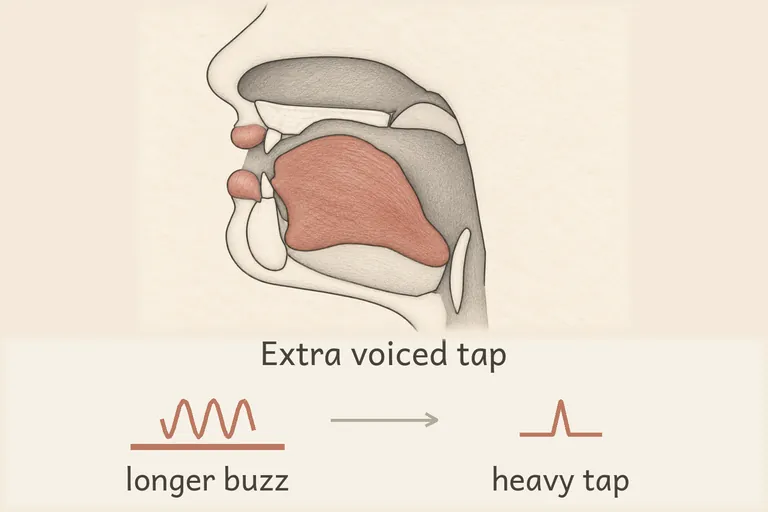
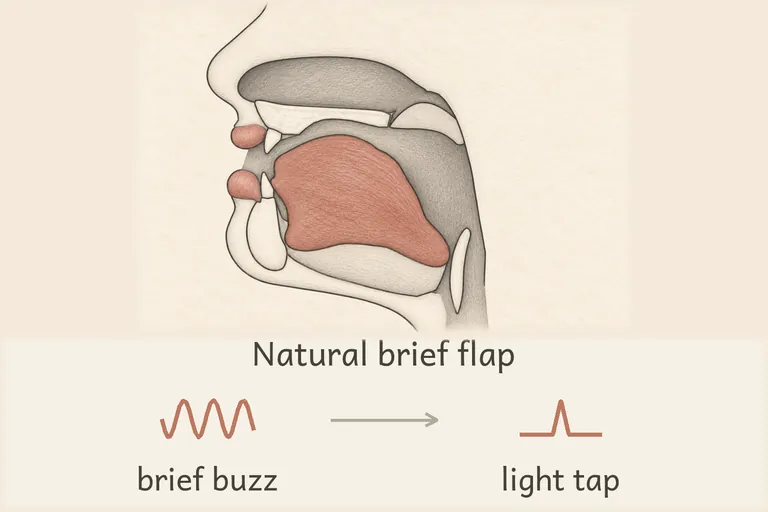
Why this works. Briefly over-voicing the flap so it sounds almost exactly like 'd' lets the learner feel the shortened, ballistic tongue-tip gesture in isolation before dialing it back toward the authentic, lighter flap; exaggerated acoustic contrast sharpens the learner's internal motor-perceptual target before fine-tuning to a natural variant.
Sources (1)
- The Role of Temporal Acoustic Exaggeration in High Variability Phonetic Training: A Behavioral and ERP Study — Bing Cheng, Xiaojuan Zhang, Siying Fan et al., 2019
- The HVPT-E group showed greater improvement in natural word identification performance compared to the standard HVPT group.
- Training with temporal acoustic exaggeration induced native-like categorical perception based on spectral cues.
- MMN responses demonstrated training-induced changes at pre-attentive neural levels, suggesting enhanced brain plasticity.
Drill the Light Tap
sourced- Read 'I'd better get some butter and water' slowly, saying each t as a full crisp stop first.
- Say it again, turning only the t's in 'better', 'butter', and 'water' into quick taps.
- Speed up to a natural conversational pace while keeping those taps light.
- Do the same two-step process with 'What a pretty little city!'.
- Record both sentences at natural speed.
- Listen back and circle any t that still sounds like a full, held stop.
- Redo just those words with extra-light, extra-fast tongue taps.
Success check: At natural speed, the t's between vowels sound like quick taps close to a fast 'd', not crisp held stops.
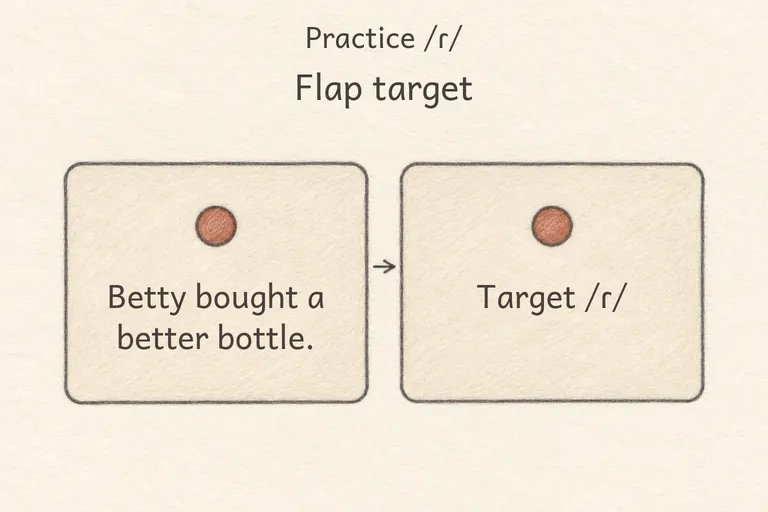
Why this works. Repeating a carrier sentence dense with intervocalic t/d gives multiple back-to-back opportunities to practice converting a full stop into a tap, letting the learner build consistent tongue-tip timing across several words in one breath group.
Sources (1)
- Targeted Pronunciation Instruction in Multilingual Classrooms... — 2025
- Vowel contrast accuracy improved significantly from 62.5% to 78.3% in the targeted group, compared to only a 2.3% gain in the control group.
- Stress accuracy rose from 60.8% to 76.4% for learners receiving targeted instruction, with large effect sizes (d=1.48 for vowels, d=0.92 for stress).
- Qualitative data revealed that learners adopted durable strategies such as minimal pair drills and shadowing, leading to fewer real-world misunderstandings.
Shadow the Quick Tap
consensus- Listen to the recording of 'I'd better get some butter and water' at normal speed.
- Play it again and start speaking a beat behind it, matching its speed exactly.
- Let the t's in 'better', 'butter', and 'water' turn into one quick, light tap rather than a crisp stop.
- Record your shadowed version.
- Compare your t sounds to the model's — they should sound almost like a fast 'd'.
- Repeat with 'What a pretty little city!' at the same brisk pace.
Success check: The t's in 'better', 'butter', 'water', 'pretty', 'little', and 'city' sound like one quick, soft tap rather than a held, crisp stop.
Why this works. Shadowing connected speech at natural speed forces the tongue tip to execute a single quick contact rather than a held stop, because the fast timing window of shadowing does not allow time for the longer closure duration typical of a fully released, Hungarian-style stop.
Sources (1)
- Wells, J.C. (1982). Accents of English.
Reader ratings and feedback are coming soon.
Sources (1)
- Duanmu, S. (2007). The Phonology of Standard Chinese. Oxford University Press.