Linking
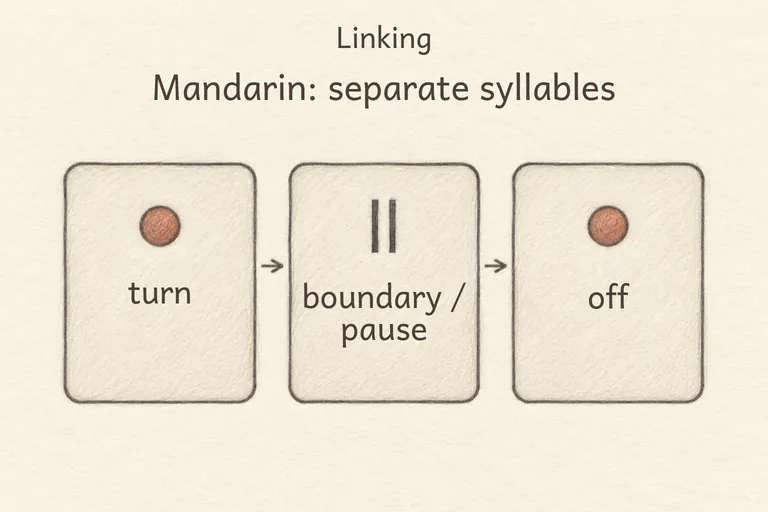
You likely pronounce each English word as its own separate unit, sometimes adding a small pause or a slight glottal catch between words, the way Mandarin syllables stay discrete even in fast speech.
What you probably do
You likely pronounce each English word as its own separate unit, sometimes adding a small pause or a slight glottal catch between words, the way Mandarin syllables stay discrete even in fast speech.
How natives do it
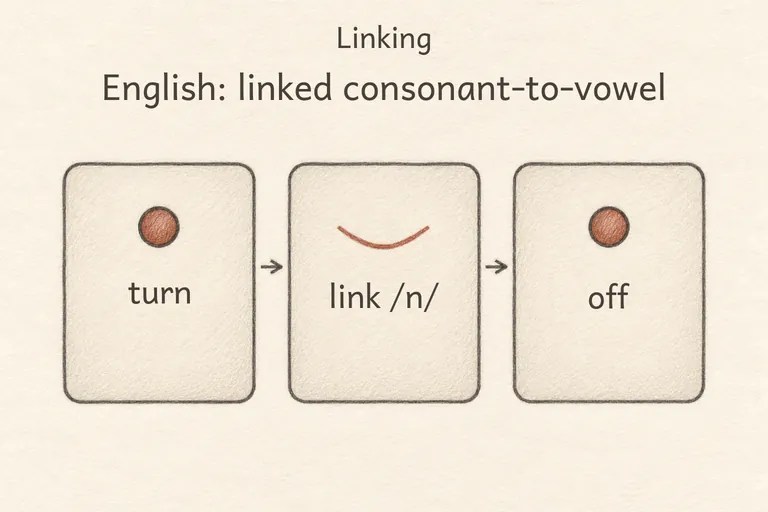
Americans slide a word-final consonant directly into the vowel that starts the next word, so 'turn it off' sounds more like 'tur-ni-toff,' blending words together for smoother, faster rhythm.
Why it matters
Without this linking, your English can sound choppy and overly segmented, and native listeners may find it harder to follow the natural flow, since they rely on linked sounds to group words into meaningful chunks.
How the mouth differs
English regularly links a word-final consonant into a following vowel-initial word ('turn it off' → tur-ni-toff) to maintain smooth stress-timed rhythm; Mandarin syllables are discrete, self-contained units that are not phonotactically linked across word boundaries, so each syllable tends to stay separate even in fluent speech.
Listen for the pattern
Mandarin-accented English often inserts small pauses, glottal stops, or clearly separates words that should flow together, which disrupts the smooth connected-speech rhythm native listeners expect.
Try these sentences
- Turn it off before you leave.'turn it off' links to 'tur-ni-toff'
- I'll pick it up later.'pick it up' links to 'pi-ki-tup'
Reader ratings and feedback are coming soon.
Sources (1)
- Duanmu, S. (2007). The Phonology of Standard Chinese. Oxford University Press.