Wh-question intonation
You likely keep your pitch fairly even across an English wh-question, similar to how Mandarin relies on the question word itself rather than pitch movement to signal the question.
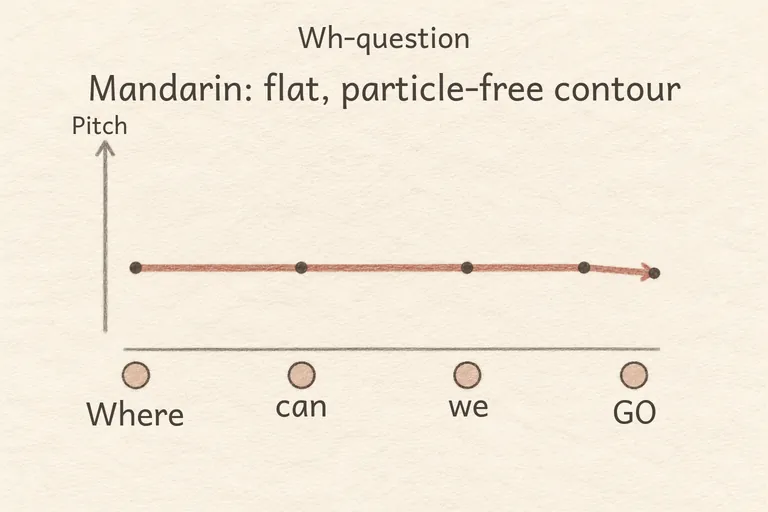
What you probably do
You likely keep your pitch fairly even across an English wh-question, similar to how Mandarin relies on the question word itself rather than pitch movement to signal the question.
How natives do it
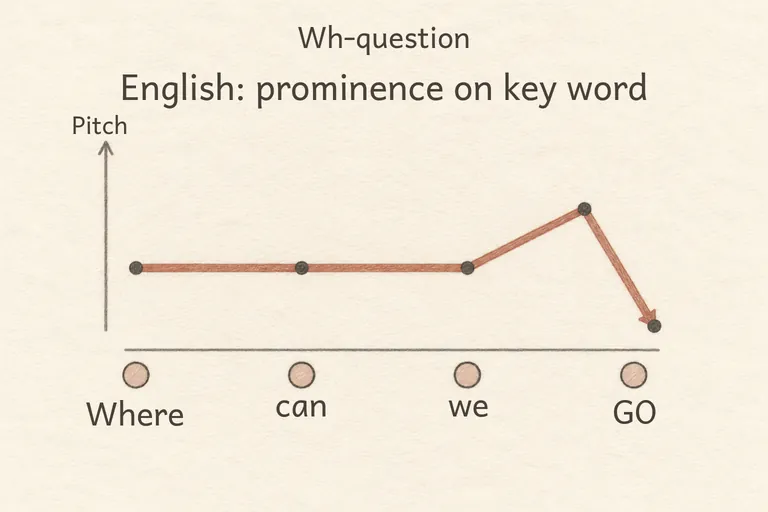
Americans add clear stress and pitch prominence to the most important content word in the question, then let pitch fall at the very end, similar to a statement but with that extra emphasis built in.
Why it matters
Without that prominence, wh-questions can sound flat, bored, or even slightly rude to native listeners, who expect a bit more pitch energy on the key information word being asked about.
How the mouth differs
Mandarin wh-questions follow a contour close to ordinary statements since the question word itself marks the question type, producing little extra pitch movement; English wh-questions usually fall at the end like statements but still carry clear stress and pitch prominence on the key content word, which Mandarin transfer can under-produce.
Listen for the pattern
Mandarin-accented English wh-questions can sound flatter or less engaged than native speech, since the extra pitch energy English speakers put on the focused word is often missing.
Try these sentences
- Where did you put my keys?prominence on 'keys', then pitch falls
- What time does the movie start?prominence on 'start', final fall
Reader ratings and feedback are coming soon.
Sources (1)
- Duanmu, S. (2007). The Phonology of Standard Chinese. Oxford University Press.