/f/as in fish
You likely produce f just fine at the start of words like 'fish', but at the end of words like 'laugh' or 'half' you may drop it completely or add a tiny extra vowel sound afterward, because Mandarin syllables never…
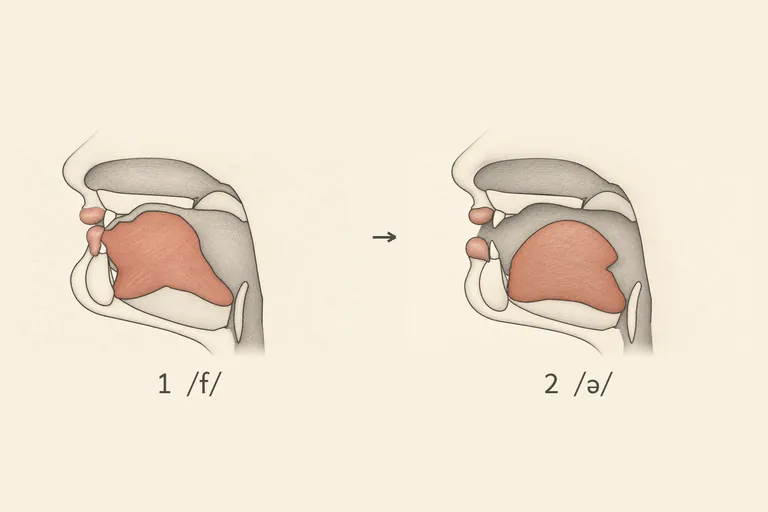
What you probably do
You likely produce f just fine at the start of words like 'fish', but at the end of words like 'laugh' or 'half' you may drop it completely or add a tiny extra vowel sound afterward, because Mandarin syllables never close on a fricative like this.
How natives do it
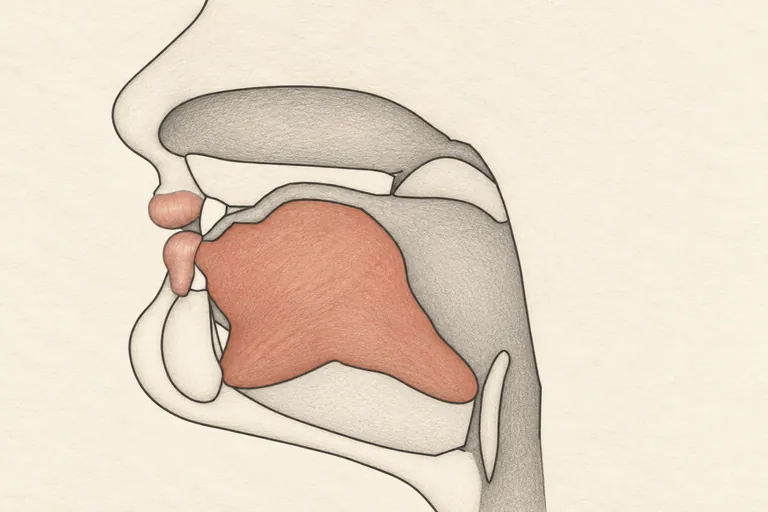
Americans keep the lower lip lightly pressed to the upper teeth right through the end of the word, letting the airy hiss continue and then simply stop — no vowel sneaks in afterward, and the word stays a single clean syllable.
Why it matters
Dropping or softening final f can make 'laugh' sound like 'law' or turn one-syllable words into two, which disrupts the steady stressed-syllable rhythm that American listeners use to track speech and can cost you clarity in fast conversation.
Hear the difference
Words this touches
How the mouth differs
Mandarin permits f only as a syllable onset; no Mandarin syllable can end in a fricative, since codas are limited to a vowel, n, or ng. English freely allows f in coda position ('laugh', 'half'). Learners transfer this gap by dropping the final f entirely or inserting a short vowel after it, turning a one-syllable English word into something that sounds two-syllable.
Listen for the pattern
Dropping or softening the final f can make words sound unfinished or merge with a different word (e.g., 'laugh' drifting toward 'law'), and the added vowel creates an extra syllable that disrupts English rhythm, both of which slow listener recognition.
Reader ratings and feedback are coming soon.
Sources (2)
- Common Accent Features of Mandarin Chinese Speakers in English — 2026
- Mandarin speakers frequently soften or drop final consonants (e.g., 'seat' becoming 'see') because Mandarin syllables rarely end in stops.
- An extra schwa vowel (/ə/) often appears at the end of English words, creating an unnatural two-syllable rhythm where English requires a single stressed syllable.
- Consonant clusters common in English (e.g., 'texts', 'school') are simplified or omitted by Mandarin speakers due to the language's avoidance of stacked consonants.
- Pronunciation Challenges Chinese Speakers Face in English — 2020
- Chinese speakers tend to break English consonant clusters by inserting a vowel or dropping one or more consonants because Chinese lacks final clusters and limits initial clusters to two consonants (one being Y/W).
- The dark L /ɫ/ does not exist in Mandarin, leading speakers to replace it with a schwa [ə] or unrounded u sound, often resulting in words like 'people' sounding like 'pipo'.
- Speakers frequently nasalize vowels at the end of syllables instead of producing the alveolar /n/, causing confusion between /n/ and /ŋ/ (e.g., 'sin' vs. 'sing').
Loads videos from YouTube via YouGlish; YouTube may set cookies.
leaf in YouGlish examples