/m/as in man
At the end of words like 'team' or 'him', you may unconsciously switch to an n-like sound made with your tongue tip, because Mandarin syllables can end in n or ng but never in m.
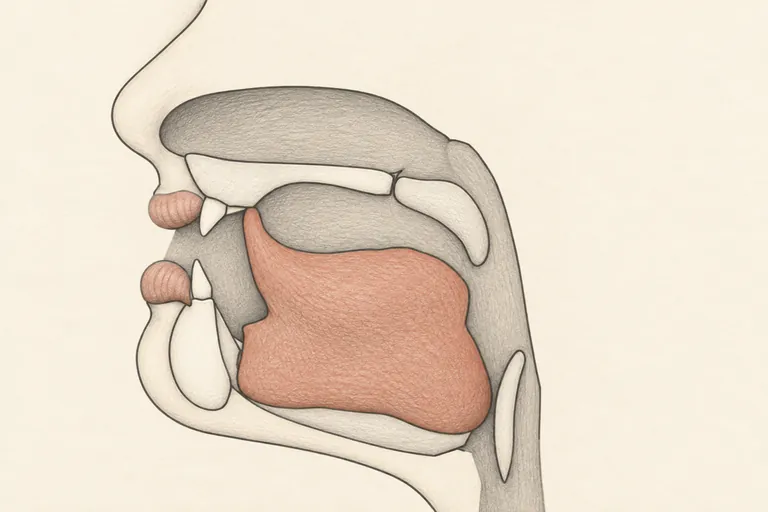

What you probably do
At the end of words like 'team' or 'him', you may unconsciously switch to an n-like sound made with your tongue tip, because Mandarin syllables can end in n or ng but never in m.
How natives do it
Americans close the lips completely and let the hum resonate through the nose right at the end of the word, without ever raising the tongue tip — the lips alone do the final closing, keeping m clearly distinct from n.
Why it matters
Swapping final m for n can turn 'team' into something closer to 'teen' or blur 'him' toward an n-ending word, creating genuine confusion for listeners rather than just sounding foreign.
Hear the difference
Words this touches
Mandarin Chinese speakers often substitute /n/.
How the mouth differs
Modern Mandarin only allows n or ng as syllable-final nasals; a word-final bilabial nasal like English m ('team', 'him') has no native counterpart in coda position. Learners frequently substitute the more familiar alveolar n, merging English minimal pairs like 'team' and 'teen' or 'him' and (an imagined) 'hin'.
Listen for the pattern
Because English distinguishes meaning using final m versus n (team vs. teen, him vs. hint-type confusions in context), the merger can create real lexical ambiguity, not just an accent flavor, especially in isolated words without strong context.
Reader ratings and feedback are coming soon.
Sources (1)
- Pronunciation Challenges Chinese Speakers Face in English — 2020
- Chinese speakers tend to break English consonant clusters by inserting a vowel or dropping one or more consonants because Chinese lacks final clusters and limits initial clusters to two consonants (one being Y/W).
- The dark L /ɫ/ does not exist in Mandarin, leading speakers to replace it with a schwa [ə] or unrounded u sound, often resulting in words like 'people' sounding like 'pipo'.
- Speakers frequently nasalize vowels at the end of syllables instead of producing the alveolar /n/, causing confusion between /n/ and /ŋ/ (e.g., 'sin' vs. 'sing').
Loads videos from YouTube via YouGlish; YouTube may set cookies.
him in YouGlish examples