/ʃ/as in ship
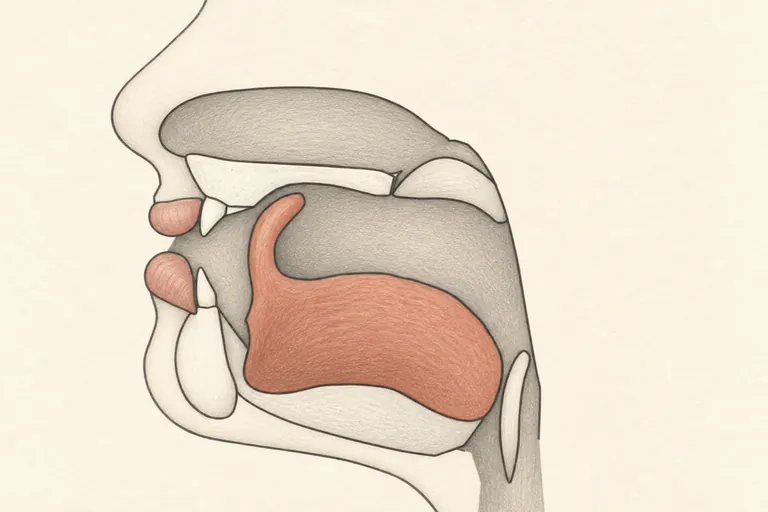
You probably substitute your native retroflex 'sh' sound (pinyin sh), curling the tongue tip further back than English requires, since this is the closest and most automatic match in your existing sound system for this…
What you probably do
You probably substitute your native retroflex 'sh' sound (pinyin sh), curling the tongue tip further back than English requires, since this is the closest and most automatic match in your existing sound system for this kind of hushing consonant.
How natives do it
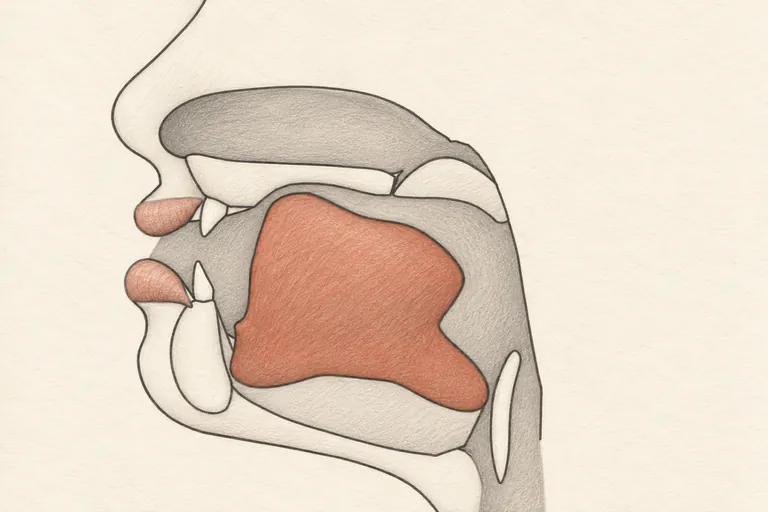
Americans bunch the tongue blade up toward the hard palate just behind the gum ridge, without curling the tongue tip backward, and round the lips slightly forward, producing a softer hushing quality than the more retroflexed Mandarin version.
Why it matters
This difference is subtle and rarely causes real misunderstanding, but easing off the tongue-tip curl and relying more on lip rounding will make your 'sh' sound less hard-edged and closer to the natural English quality, smoothing out a feature that can mark a noticeable accent.
Hear the difference
Words this touches
Mandarin Chinese speakers often substitute /ʂ, ɕ/.
How the mouth differs
Mandarin has two close relatives of English ʃ: the retroflex ʂ (pinyin 'sh', made with the tongue tip curled back) and the alveolo-palatal ɕ (pinyin 'x', made with the tongue blade raised toward the hard palate). English ʃ sits between these, bunched just behind the alveolar ridge without full retroflexion. Learners often substitute the more retroflexed ʂ, giving the sound a slightly harder, more curled-back quality.
Listen for the pattern
Because ʂ and English ʃ sound quite similar to most listeners, this substitution rarely blocks understanding, but it can give the accent a subtly 'harder' or more retroflexed quality that is noticeable to trained ears.
Practise it
Hear the Difference: ship vs sip vs chip
consensus- Listen to the pair 'ship' and 'sip' without looking at the spelling.
- Notice whether the first sound is a broader, rounder hiss (ship) or a thinner, sharper hiss (sip).
- Write down which word you heard first.
- Now listen to 'shoe' and 'chew' and notice whether the first sound flows continuously (shoe) or starts with a tiny click before the hiss (chew).
- Repeat both pairs five times each, tracking your accuracy.
- Mix all four words in random order and try to identify each one by its starting sound alone.
- Replay any word you got wrong three times, focusing only on rounding and stop-versus-flow.
Success check: You should correctly identify at least 7 of 8 random presentations, reliably telling apart the continuous rounded hiss of 'sh' from the thinner 's' and the clicking 'ch'.
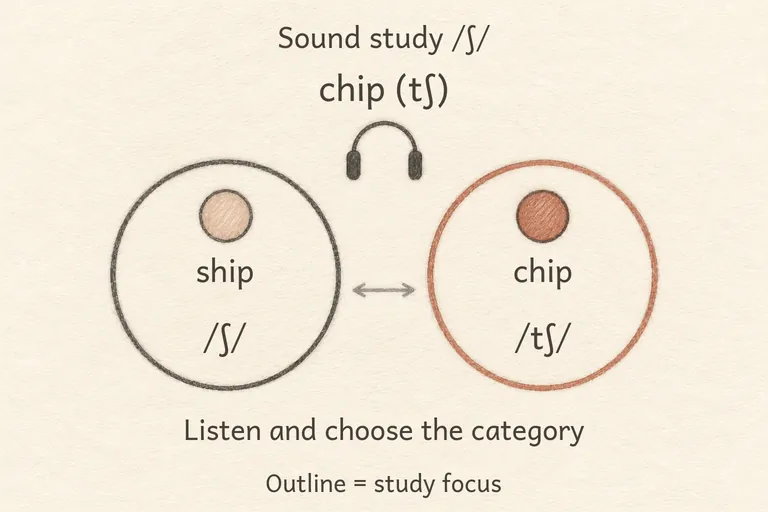
Why this works. Discriminating ʃ from its two competing substitutes, tʃ and s, requires attending to continuous turbulent airflow without closure (versus tʃ's stop-release) and to a broader, more retracted channel (versus s's narrower, more forward one); minimal-pair listening builds this three-way perceptual boundary before production work begins.
Sources (2)
- Wells, J.C. (1982). Accents of English.
- Hualde, J.I. (2005). The Sounds of Spanish. Cambridge University Press.
Say It Right: ship, not chip or sip
consensus- Stand in front of a mirror and round your lips forward as if about to whistle.
- While keeping your lips rounded, raise the middle of your tongue toward the roof of your mouth, a little further back than you would for 's'.
- Push air through continuously without ever letting your tongue fully touch the roof of your mouth — there should be no stopping or clicking sound.
- Say 'ship' using this rounded, continuous-airflow setup.
- Record yourself and check that you don't hear a little 'ch' click at the start, and that it doesn't sound as thin as 's'.
- Repeat with 'wish' and 'shoe', keeping the same lip-rounded, no-closure technique.
- Compare your recordings to the words 'witch' and 'chew' to confirm you avoided the stop closure.
Success check: Your recordings should have a continuous, rounded hiss with no clicking closure at the start, clearly distinguishable from both 'chip' and 'sip'.
Why this works. Producing the contrastive pairs requires the learner to actively round the lips and retract the tongue channel further back than for 's', while suppressing any stop closure carried over from tʃ, consolidating the unique motor plan for ʃ that neither of the two competing L1 sounds provides.
Sources (2)
- Wells, J.C. (1982). Accents of English.
- Hualde, J.I. (2005). The Sounds of Spanish. Cambridge University Press.
Reader ratings and feedback are coming soon.
Sources (1)
- Duanmu, S. (2007). The Phonology of Standard Chinese. Oxford University Press.
Loads videos from YouTube via YouGlish; YouTube may set cookies.
ship in YouGlish examples