/r/as in red
You likely produce English r with a bit of buzzing friction, closer to the Mandarin retroflex sound, or swap it for an l-like glide.
What you probably do
You likely produce English r with a bit of buzzing friction, closer to the Mandarin retroflex sound, or swap it for an l-like glide. After vowels, as in 'car' or 'bird', you may drop the r sound entirely or just lengthen the vowel instead of adding the rhotic color.
How natives do it
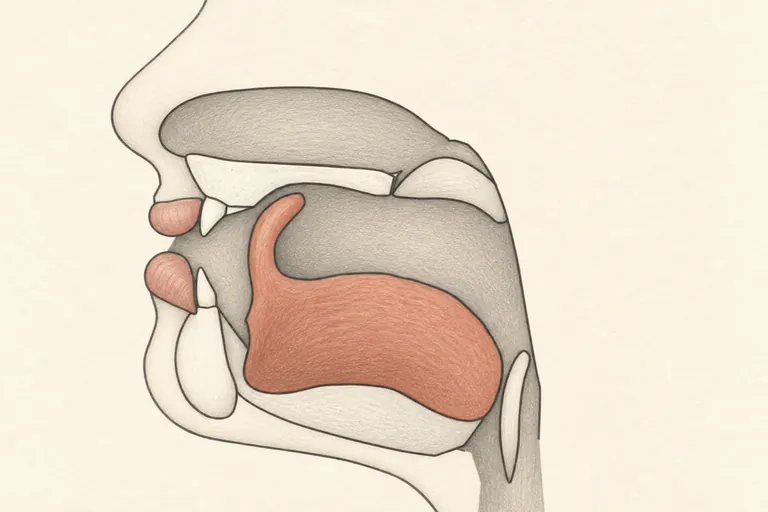
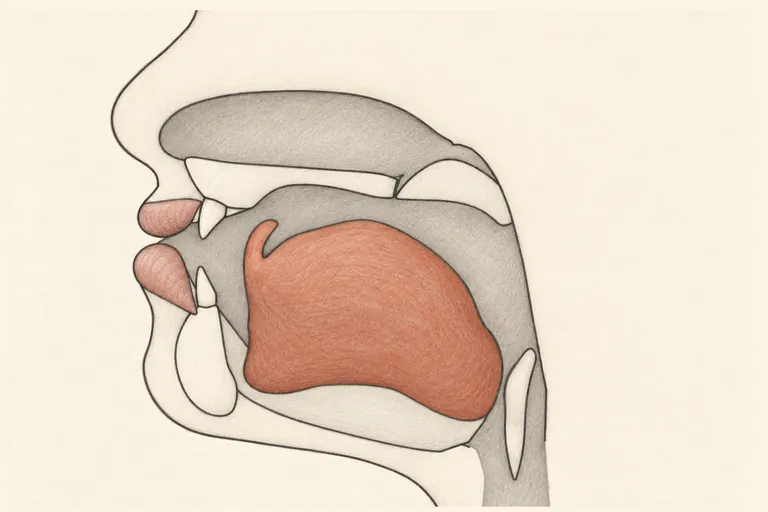
Americans round their lips slightly and either curl the tongue tip up and back or bunch the tongue body, without ever touching the roof of the mouth, keeping the airflow smooth. Crucially, this same tongue shape also appears after vowels, giving words like 'car' and 'world' their distinctive coloring.
Why it matters
Because /r/ appears in so many common English words and in both onset and coda position, consistent mispronunciation quickly flags a foreign accent and can create real confusion between pairs like 'right' and 'light', or make coda-r words hard to recognize at all.
Hear the difference
Words this touches
Mandarin Chinese speakers often substitute /ʐ, l/.
How the mouth differs
Mandarin's closest sound, the retroflex ʐ, involves a narrow channel with audible friction and appears only before vowels, never after them. English /r/ is a frictionless approximant that also colors vowels in coda position ('car', 'bird'), a syllable shape Mandarin phonotactics do not permit.
Listen for the pattern
Listeners often hear onset r as an l-like glide or a buzzy ʐ, and perceive coda r as missing or replaced by a lengthened vowel, which is a strong marker of a Chinese accent.
Practise it
Overdo your r, then dial it back
sourced- Say 'rrrred' with a huge, cartoonish, extra-long r — really curl your tongue back and hold it.
- Repeat this exaggerated version five times, exaggerating the lip rounding too.
- Record yourself doing the exaggerated version and check it sounds nothing like a tap or trill.
- Now say the same word with a shorter, lighter version of that same tongue shape.
- Compare the two recordings: the natural version should use the identical tongue posture, just quicker and smaller.
- Practice five more words this way (right, around, carry, door, wrong), exaggerated then natural.
- Finish by saying all five words at normal conversational speed, keeping only the natural-sized version.
Success check: Your natural-speed r should feel like a smaller version of the exaggerated one — same tongue shape, just faster and lighter — and never a tap.
Why this works. Temporarily overshooting the retroflex curl or tongue-bunching (holding it longer and further back than natural speech requires) exaggerates the spectral cue (lowered F3) that distinguishes r from the L1 trill/tap. High-variability training research shows that acoustic/articulatory exaggeration during early training drives faster, more native-like categorical perception and production than practicing at natural, subtle target values from the start; the exaggeration is then dialed back once the new category is established.
Sources (1)
- The Role of Temporal Acoustic Exaggeration in High Variability Phonetic Training: A Behavioral and ERP Study — Bing Cheng, Xiaojuan Zhang, Siying Fan et al., 2019
- The HVPT-E group showed greater improvement in natural word identification performance compared to the standard HVPT group.
- Training with temporal acoustic exaggeration induced native-like categorical perception based on spectral cues.
- MMN responses demonstrated training-induced changes at pre-attentive neural levels, suggesting enhanced brain plasticity.
Hear the difference: r vs. l
sourced- Get a list of paired words: red/led, rice/lice, right/light, wrong/long.
- Have someone (or a recording) say one word from each pair in random order.
- Close your eyes and just listen — do not try to say anything yet.
- Write down or say aloud which word you heard, r-word or l-word.
- Check your answers against the list.
- Replay any pair you missed at least three times before moving on.
- Repeat the whole list until you score at least 9 out of 10 correct twice in a row.
Success check: You should be able to tell r-words from l-words correctly almost every time, even when the speaker says them quickly, without needing to see anyone's mouth.
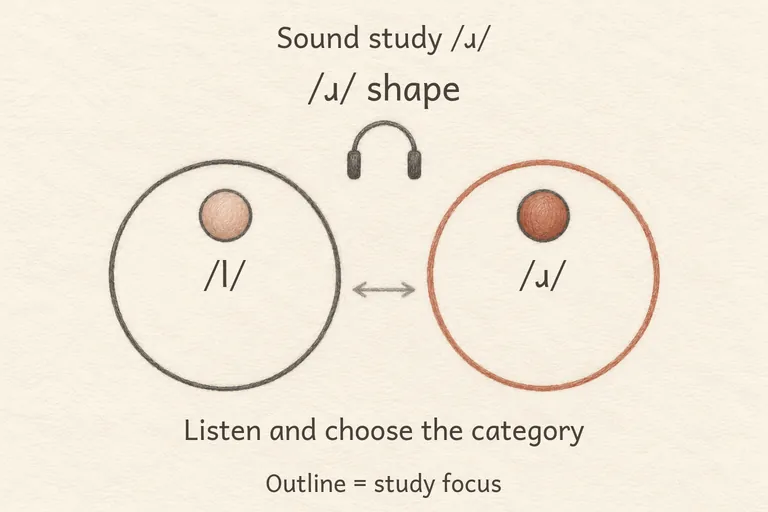
Why this works. Listeners whose L1 lacks the English approximant r tend to map it onto their nearest native category (trill/tap r) or confuse it with l, since the acoustic cue (low F3) is not phonemically relevant in their L1. Forced-choice identification with minimal pairs (r vs l) trains a new perceptual category boundary before production is attempted, which is the standard first step in phonetic training paradigms.
Sources (1)
- Distinguishing universal and language-dependent levels of speech perception: Evidence from Japanese listeners' perception of English “l” and “r” — Virginia A. Mann, 1986
- Japanese listeners successfully discriminate the acoustic properties of English /l/ and /r/ when presented with non-English contrasts, ruling out a universal hearing deficit.
- The primary source of error is language-dependent categorization, where listeners map English sounds onto their existing L1 phonological categories (e.g., classifying both as liquids).
- Performance improves significantly when the acoustic contrast between /l/ and /r/ is exaggerated or presented in contexts that highlight their distinctiveness.
Drill sentence: r in every position
sourced- Read this sentence slowly first: 'The red car drove around the narrow road.'
- Mark every r with a pencil dot so you notice each one.
- Say the sentence very slowly, holding each r-shape for an extra beat.
- Record yourself saying it at a normal conversational speed.
- Listen back and circle any r that sounds tapped, trilled, or clipped.
- Repeat the sentence three more times, focusing only on the r's you circled.
- Say the whole sentence five times at natural speed until every r is smooth.
Success check: You can say the full sentence at normal speed with every r sounding smooth and continuous, with no tapping sound anywhere.
Why this works. High-density carrier sentences that repeat the target segment in varied positions (initial, medial, post-vocalic) push the newly trained approximant gesture toward automaticity under connected-speech demands, which is where trained sounds most often revert to L1 defaults. Recording provides the self-feedback loop that sustains gains outside guided practice.
Sources (1)
- Targeted Pronunciation Instruction in Multilingual Classrooms... — 2025
- Vowel contrast accuracy improved significantly from 62.5% to 78.3% in the targeted group, compared to only a 2.3% gain in the control group.
- Stress accuracy rose from 60.8% to 76.4% for learners receiving targeted instruction, with large effect sizes (d=1.48 for vowels, d=0.92 for stress).
- Qualitative data revealed that learners adopted durable strategies such as minimal pair drills and shadowing, leading to fewer real-world misunderstandings.
Say it and check: r vs. l
consensus- Say 'light' slowly, feeling your tongue tip touch behind your top teeth.
- Now say 'right', keeping your tongue tip pulled back and away from that spot the whole time.
- Record yourself saying the pairs: red/led, rice/lice, right/light, wrong/long.
- Play it back and ask: on the r-word, did my tongue ever touch anything?
- If it touched, slow down and pull the tongue tip further back before starting the vowel.
- Re-record the pair until the r-word sounds smooth and continuous, with no little tap or flick.
- Move to a new pair only after two clean recordings in a row.
Success check: On playback, your r-words should sound smooth and 'liquid' with no tapping noise, and clearly different from your l-words.
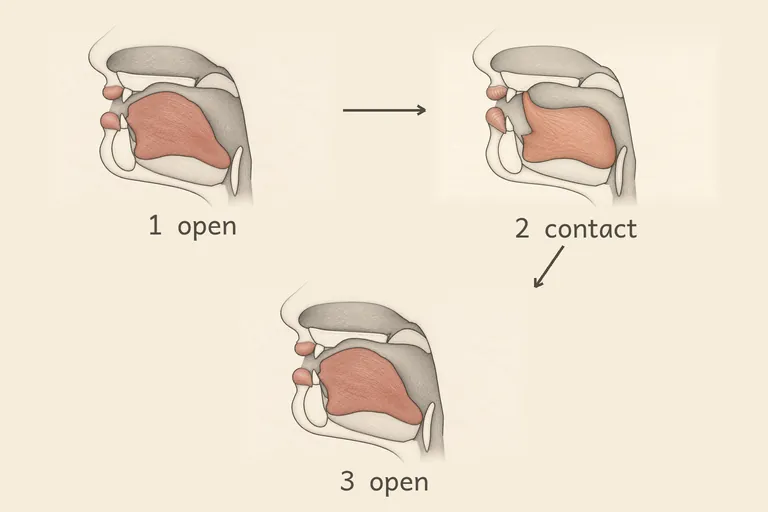
Why this works. Production practice on the same minimal pairs used for perception links the newly trained auditory category to a motor target. Recording and comparing forces self-monitoring of the key articulatory cue (absence of tongue-alveolar contact), since Hungarian speakers cannot rely on kinesthetic feedback from a trill/tap to judge correctness.
Sources (1)
- Wells, J.C. (1982). Accents of English.
Borrow a growl to find your r
consensus- Make a short, playful growling sound, like an animal, 'grrrr', without using your voice box for actual r yet.
- Notice how the back and middle of your tongue pull backward and bunch up for the growl.
- Do the growl again and freeze your tongue in that exact position.
- While holding that frozen tongue shape, round your lips slightly and add your voice.
- Let the sound turn into a stretched 'errrr' without moving your tongue from the growl position.
- Now shorten it into a normal-length r sound at the start of 'red' or 'right'.
- Check in the mirror that your tongue never touches the roof of your mouth during the shift.
Success check: The r you produce right after the growl should feel like the exact same tongue posture, just voiced and shaped into a vowel-like sound, with no tongue contact.
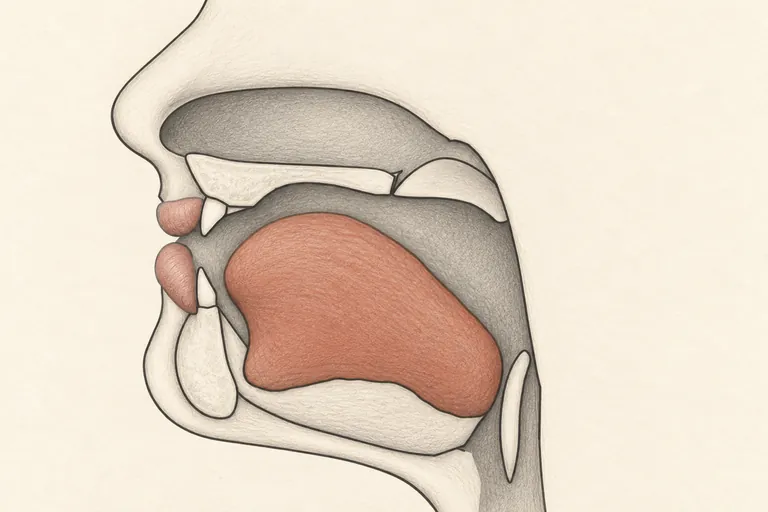
Why this works. A low growl (as in imitating a dog or bear) recruits tongue-dorsum retraction and pharyngeal narrowing via the styloglossus and palatoglossus muscles, the same muscle group used to bunch or retract the tongue body for the bunched variant of English r. Borrowing this already-automatic non-speech gesture gives learners immediate access to the correct tongue posture without needing new motor learning from scratch.
Sources (1)
- Wells, J.C. (1982). Accents of English.
Build the r-shape one step at a time
consensus- Sit in front of a mirror and open your mouth slightly.
- Step 1: rest your tongue flat, tip near your lower front teeth.
- Step 2: very slowly lift and curl the tongue tip up and back — or slowly bunch the middle of your tongue upward — stopping before it touches anything.
- Step 3: hold that curled or bunched shape for two full seconds while rounding your lips slightly.
- Watch in the mirror: there should be a visible gap between your tongue and the roof of your mouth.
- Now say a stretched-out 'rrrr' while holding that exact shape.
- Speed the three steps up gradually until they blend into one smooth 'r' at normal speed.
Success check: You can watch your tongue rise and curl in the mirror without ever touching the roof of your mouth, and the sound stays smooth with no clicking or tapping.
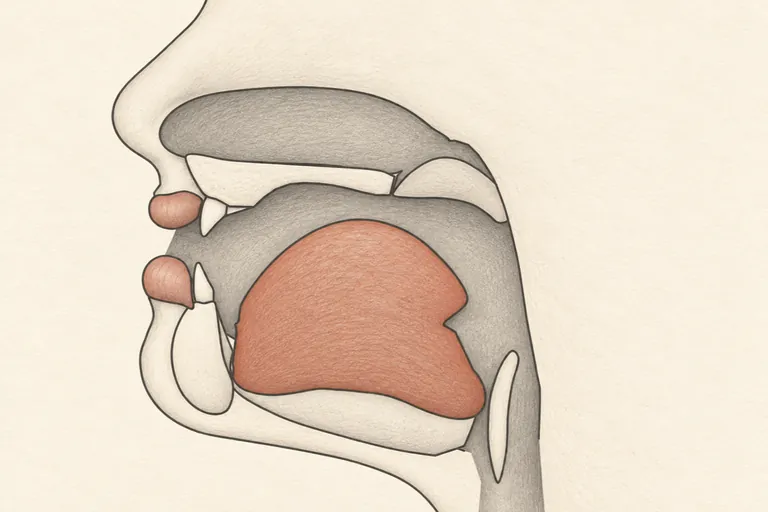
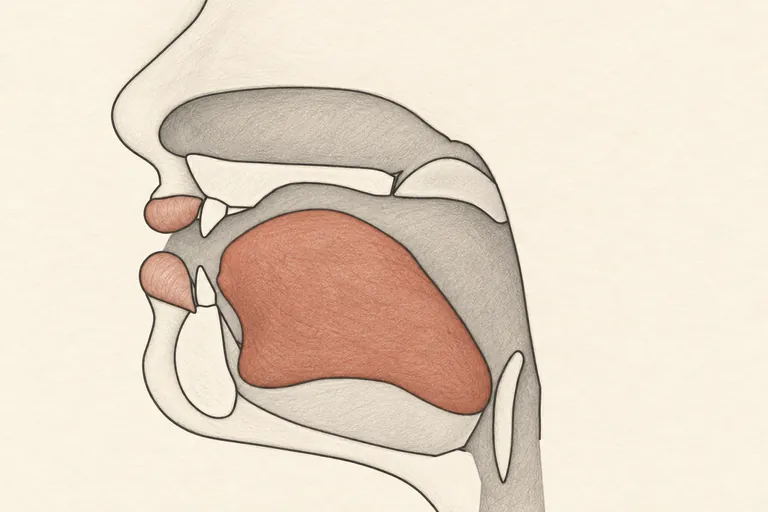
Why this works. Slowing the gesture down lets the learner consciously monitor the tongue's trajectory rather than defaulting to the fast, overlearned trill/tap motor program. Breaking the approximant into discrete steps (starting position, mid curl, held target, release) makes the normally invisible no-contact posture visible via a mirror and checkable in real time.
Sources (1)
- Wells, J.C. (1982). Accents of English.
Reader ratings and feedback are coming soon.
Sources (1)
- Duanmu, S. (2007). The Phonology of Standard Chinese. Oxford University Press.
Loads videos from YouTube via YouGlish; YouTube may set cookies.
right in YouGlish examples