/ʊ/as in book
Seeing English spellings like 'oo' or 'u', you may reach for the tense, strongly rounded long vowel you use in Hindi ऊ, making words like 'book' or 'put' sound a little too full or rounded, closer to 'boot' or 'poot'.
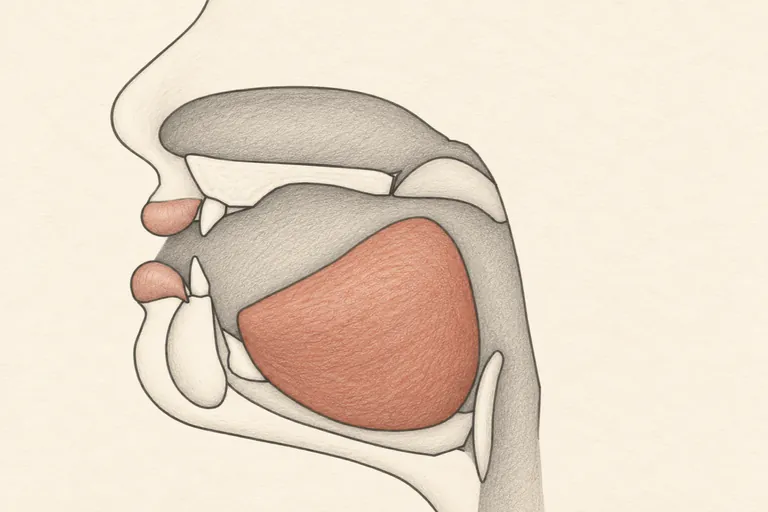
What you probably do
Seeing English spellings like 'oo' or 'u', you may reach for the tense, strongly rounded long vowel you use in Hindi ऊ, making words like 'book' or 'put' sound a little too full or rounded, closer to 'boot' or 'poot'.
How natives do it
Americans relax the tongue and round the lips only lightly for this vowel, keeping it short and loose — think of the brief, unassuming 'oo' in 'book' rather than the long, deliberate 'oo' in 'boot'.
Why it matters
Over-rounding and lengthening this vowel rarely causes real misunderstanding, but it blurs the useful distinction between short ʊ words like 'full' and long u words like 'fool', so practicing a quicker, looser version helps your vowels sound crisper and more native.
Hear the difference
Words this touches
Hindi (Modern Standard Hindi) speakers often substitute /uː/.
How the mouth differs
Hindi has a short ʊ, but because English 'oo' spellings visually resemble the Hindi long vowel ऊ, Hindi speakers often default to a tenser, more rounded quality closer to uː rather than the short, lax English ʊ, under-relaxing the tongue and over-rounding the lips.
Listen for the pattern
The resulting vowel sounds slightly too long or too 'full', nudging words like 'book' or 'put' a touch toward 'boot'/'poot' territory without actually causing a different word to be heard.
Practise it
Exaggerate, then Dial Back: Finding True ʊ
sourced- Say 'book' with your habitual tense, tightly-rounded vowel and notice how your lips feel.
- Now say 'book' again but barely round your lips at all and let your tongue go very relaxed — exaggerate in the opposite direction.
- Repeat this under-rounded, very relaxed version three times, feeling how different it is from your first attempt.
- Gradually add back a small amount of lip rounding until it feels like a light, natural rounding rather than none at all.
- Say 'book' one more time at this new, lightly-rounded, relaxed setting.
- Compare 'book' to 'boot' back to back, confirming 'book' uses much less lip tension.
- Record both words and check that they sound clearly different, with 'book' shorter and looser.
Success check: You should feel your lips staying much looser for 'book' than your old habit, and 'book' versus 'boot' should sound clearly distinct, not like the same vowel.
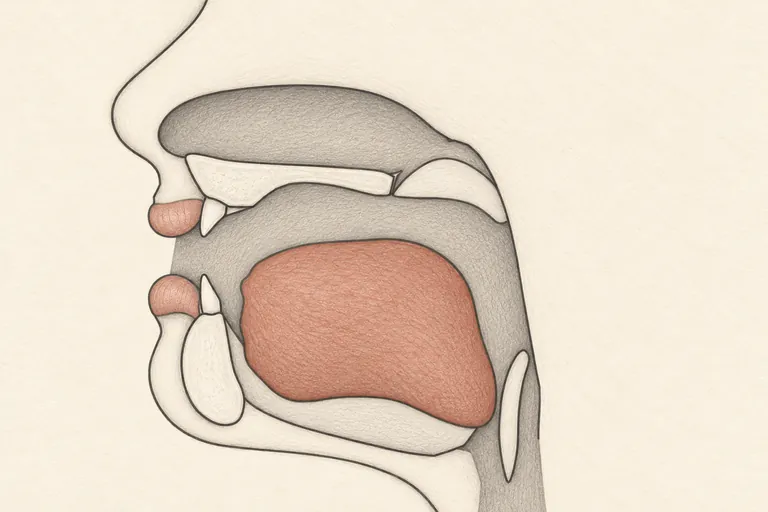
Why this works. Deliberately over-relaxing the tongue and under-rounding the lips beyond the natural ʊ target, then gradually reducing the exaggeration, pushes production away from the tense-u attractor and gives a clear articulatory landmark; exaggerated-contrast training strengthens categorical boundaries before fading into natural speech.
Sources (2)
- Distinguishing universal and language-dependent levels of speech perception: Evidence from Japanese listeners' perception of English “l” and “r” — Virginia A. Mann, 1986
- Japanese listeners successfully discriminate the acoustic properties of English /l/ and /r/ when presented with non-English contrasts, ruling out a universal hearing deficit.
- The primary source of error is language-dependent categorization, where listeners map English sounds onto their existing L1 phonological categories (e.g., classifying both as liquids).
- Performance improves significantly when the acoustic contrast between /l/ and /r/ is exaggerated or presented in contexts that highlight their distinctiveness.
- The Role of Temporal Acoustic Exaggeration in High Variability Phonetic Training: A Behavioral and ERP Study — Bing Cheng, Xiaojuan Zhang, Siying Fan et al., 2019
- The HVPT-E group showed greater improvement in natural word identification performance compared to the standard HVPT group.
- Training with temporal acoustic exaggeration induced native-like categorical perception based on spectral cues.
- MMN responses demonstrated training-induced changes at pre-attentive neural levels, suggesting enhanced brain plasticity.
Hear the Difference: full vs fool
sourced- Get a recorder or pronunciation app with audio for minimal pairs like full/fool, pull/pool, look/Luke.
- Listen to the first pair twice without looking at the spelling.
- Write down which word you think came first, 'full' or 'fool', before checking the answer.
- Replay the pair slowly, paying attention to vowel length and lip tightness, not just the consonant.
- Repeat for all three pairs, tracking how many you identify correctly on the first listen.
- If you miss any, replay them three times, focusing only on how long and tense the vowel sounds.
- Retest yourself once more after a short break to confirm the distinction has become clearer.
Success check: You should be able to correctly identify at least 5 of 6 pair members on a single listen, noticing the looser, shorter quality of ʊ compared to the tighter, longer u.
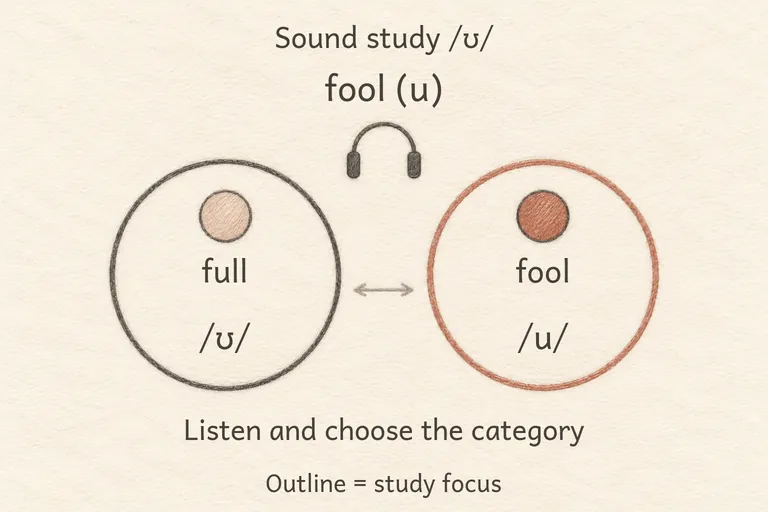
Why this works. Discrimination training on minimal pairs isolating the tense/lax vowel contrast (u vs ʊ) builds the categorical boundary missing when the L1 has only one high back rounded vowel; contrastive discrimination training is shown to improve perceptual categorization before production gains follow.
Sources (2)
- Distinguishing universal and language-dependent levels of speech perception: Evidence from Japanese listeners' perception of English “l” and “r” — Virginia A. Mann, 1986
- Japanese listeners successfully discriminate the acoustic properties of English /l/ and /r/ when presented with non-English contrasts, ruling out a universal hearing deficit.
- The primary source of error is language-dependent categorization, where listeners map English sounds onto their existing L1 phonological categories (e.g., classifying both as liquids).
- Performance improves significantly when the acoustic contrast between /l/ and /r/ is exaggerated or presented in contexts that highlight their distinctiveness.
- Using multiple measures to document change in English vowels produced by Japanese, Korean, and Spanish speakers: the case for goodness and intelligibility. — Amber D Franklin, Carol Stoel-Gammon, 2014
- Both goodness ratings and intelligibility scores effectively captured improvements in vowel accuracy following pronunciation training.
- The relationship between goodness and intelligibility varies by vowel; vowels like /æ/ and /ʌ/ depend more on goodness for listener identification than /i/ and /e/.
- Some vowels received better mean intelligibility scores but poorer mean goodness ratings after training, indicating that high intelligibility does not always require high perceived quality.
Drill Sentence: Full of Good Books
consensus- Read this sentence silently first: 'The good cook put a full book on the wooden shelf.'
- Mark every ʊ word in the sentence: good, cook, put, full, book, wooden.
- Say the sentence slowly, relaxing your lips and tongue for each marked word.
- Record yourself reading it at a slow, deliberate pace.
- Play it back and check that none of the marked words sound like their tense-u twins.
- Repeat the sentence three more times, gradually increasing to a natural conversational speed.
- Do a final recording at normal speed and confirm all six target words still sound short and relaxed.
Success check: On your final recording at natural speed, all six ʊ words should sound clearly shorter and more relaxed than if you'd used the tense u vowel, and a listener should not confuse any of them with other words.
Why this works. Embedding multiple ʊ-words in a connected, meaningful sentence forces the learner to maintain the lax-vowel target under natural speech rate and coarticulation, bridging isolated-word accuracy and fluent, intelligible speech.
Sources (1)
- Wells, J.C. (1982). Accents of English.
Say It Right: full vs fool
sourced- Stand in front of a mirror and say 'fool', watching your lips push forward and round tightly.
- Now say 'full', consciously relaxing your lips to only a light rounding and keeping the vowel short.
- Alternate 'full, fool, full, fool' five times, exaggerating the lip-tension difference each time.
- Record yourself saying both words and play it back immediately.
- Check whether 'full' sounds noticeably shorter and looser than 'fool'.
- Repeat with 'pull/pool' and 'look/Luke', applying the same relaxed-lips technique to the ʊ word.
- If a listener or app can't tell your pairs apart, slow down and relax your lips even more for the ʊ word.
Success check: A listener (or playback) should be able to tell 'full' from 'fool' reliably, and you should feel noticeably less lip tension and a shorter vowel on the ʊ word.
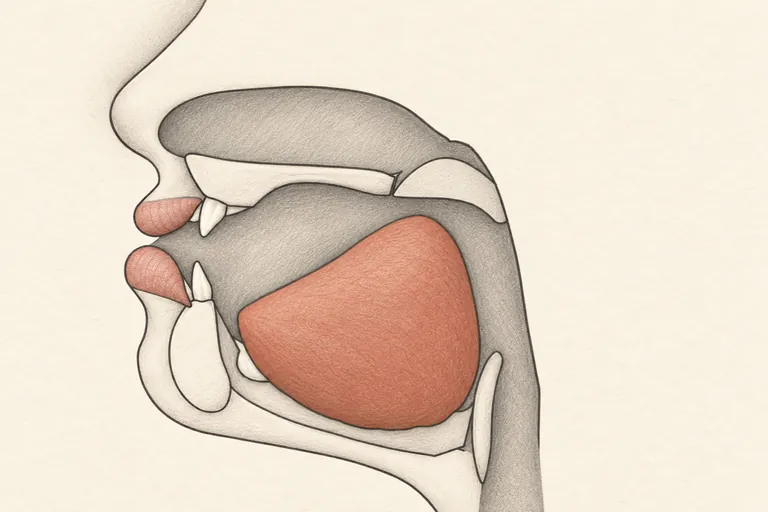
Why this works. Active production of the same minimal pairs forces control of tongue height/tension and lip rounding to keep the contrast audible; immediate self-recording and playback gives the auditory feedback loop associated with vowel-accuracy gains in L2 training.
Sources (1)
- Using multiple measures to document change in English vowels produced by Japanese, Korean, and Spanish speakers: the case for goodness and intelligibility. — Amber D Franklin, Carol Stoel-Gammon, 2014
- Both goodness ratings and intelligibility scores effectively captured improvements in vowel accuracy following pronunciation training.
- The relationship between goodness and intelligibility varies by vowel; vowels like /æ/ and /ʌ/ depend more on goodness for listener identification than /i/ and /e/.
- Some vowels received better mean intelligibility scores but poorer mean goodness ratings after training, indicating that high intelligibility does not always require high perceived quality.
Borrow a Gesture You Already Know
consensus- Say the English word 'go' slowly and notice the lip shape right at the very start of the vowel, before it glides.
- Freeze your lips in that exact starting shape — moderately rounded, not tightly pursed.
- While keeping that lip shape frozen, raise the back of your tongue a little higher and tenser than it was for 'go'.
- Add a slightly more closed jaw position while holding the frozen lip shape.
- Say 'book' using this borrowed lip shape plus the adjusted tongue position.
- Check in the mirror that your lips never pursed tightly forward the way they would for 'boot'.
- Practice switching between the start of 'go' and 'book' five times to feel how the same lip gesture adapts to two different vowels.
Success check: You should feel the same moderate lip-rounding muscle activation you use at the start of 'go', just combined with a higher, tenser tongue position — and 'book' should sound short and relaxed, not like 'boot'.
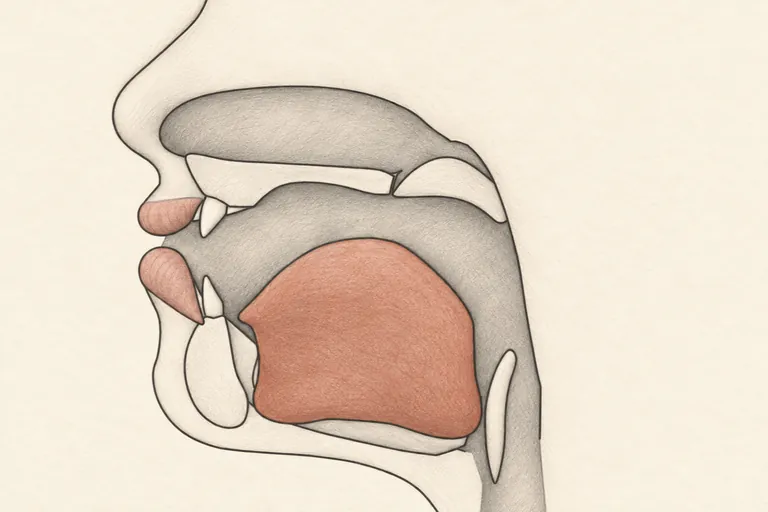
Why this works. The lip-rounding gesture for ʊ shares the same orbicularis oris activation used at the onset of the diphthong oʊ (as in 'go'), already automatized in the learner's motor repertoire; borrowing that familiar, moderate lip-rounding gesture rather than the tighter rounding of u, and pairing it with a shorter, laxer tongue position, gives learners a ready-made motor template to adapt.
Sources (1)
- Wells, J.C. (1982). Accents of English.
Build ʊ in Slow Motion
consensus- Say 'book' extremely slowly, freezing right after the 'b' sound before the vowel starts.
- Hold your jaw in a slightly open position — a touch more open than you'd use for 'boot' — and freeze there.
- Check in the mirror that your tongue is high and back but not pressed as far up as for 'boot'.
- Round your lips only lightly, without pushing them forward into a tight circle.
- Slowly release into the 'k' sound, keeping the vowel brief rather than drawn out.
- Repeat the whole slow sequence three times, then speed it up gradually until it sounds like normal 'book'.
- Compare your final fast version to 'boot' to confirm you haven't drifted back into the tense vowel.
Success check: You should feel a distinctly more relaxed jaw and lighter lip rounding for 'book' than for 'boot', and the vowel should sound short rather than drawn out.
Why this works. Decomposing the ʊ gesture into discrete, held sub-stages (jaw position, tongue height, lip rounding) at slow speed lets learners isolate and correct each articulatory parameter separately before reassembling it at normal speed, a standard technique for installing a vowel target the L1 lacks.
Sources (1)
- Wells, J.C. (1982). Accents of English.
Reader ratings and feedback are coming soon.
Sources (1)
- Wells, J.C. (1982). Accents of English.
Loads videos from YouTube via YouGlish; YouTube may set cookies.
full in YouGlish examples